2026年3月2日(月)15:15~15:45・明治大学中野キャンパス(Meiji University Nakano Campus)
「波の知覚と薄氷ドリフト錯視」(Perception of waves and the drifting fragile sheets of
ice illusion)
第20回錯覚ワークショップ(20th Illusion Workshop hosted by Professor Kokichi Sugihara)
立命館大学総合心理学部 北岡明佳 抄録 (abstract) 
2ページ目はこちら・3ページ目はこちら・4ページ目はこちら・5ページ目はこちら・6ージ目はこちら・7ページ目はこちら・8ページ目はこちら
薄氷ドリフト錯視の例(京都市から見た比叡山)
(mp4)
KDEwave-hieizan-IMG_4109p2a-.gif
等間隔に配置された縦長の長方形の「短冊」が右に動いているが、それらは左に動く背景の手前に薄い氷の膜のように浮いて見える。短冊は右に動いているが、各画素は左右に行ったり来たりしているだけである。(Vertically elongated rectangular "strips" are moving to the right at regular intervals; yet, they appear to float like a thin sheet of ice in front of the background, which is moving to the left. Although the strips are moving to the right, each pixel is merely oscillating back and forth horizontally.)
薄氷ドリフト錯視の例(山手線 駒込・田端間)
(mp4)
KDEwave-IMG_2926-frame01b-.gif
薄氷ドリフト錯視の例(立命館大学大阪いばらきキャンパス)
(mp4)
薄氷ドリフト錯視の例(錯覚美術館)
(mp4)
hakuhyo_drift-sakkakumuseum010b-.gif
薄氷ドリフト錯視の例(ランダムドット)
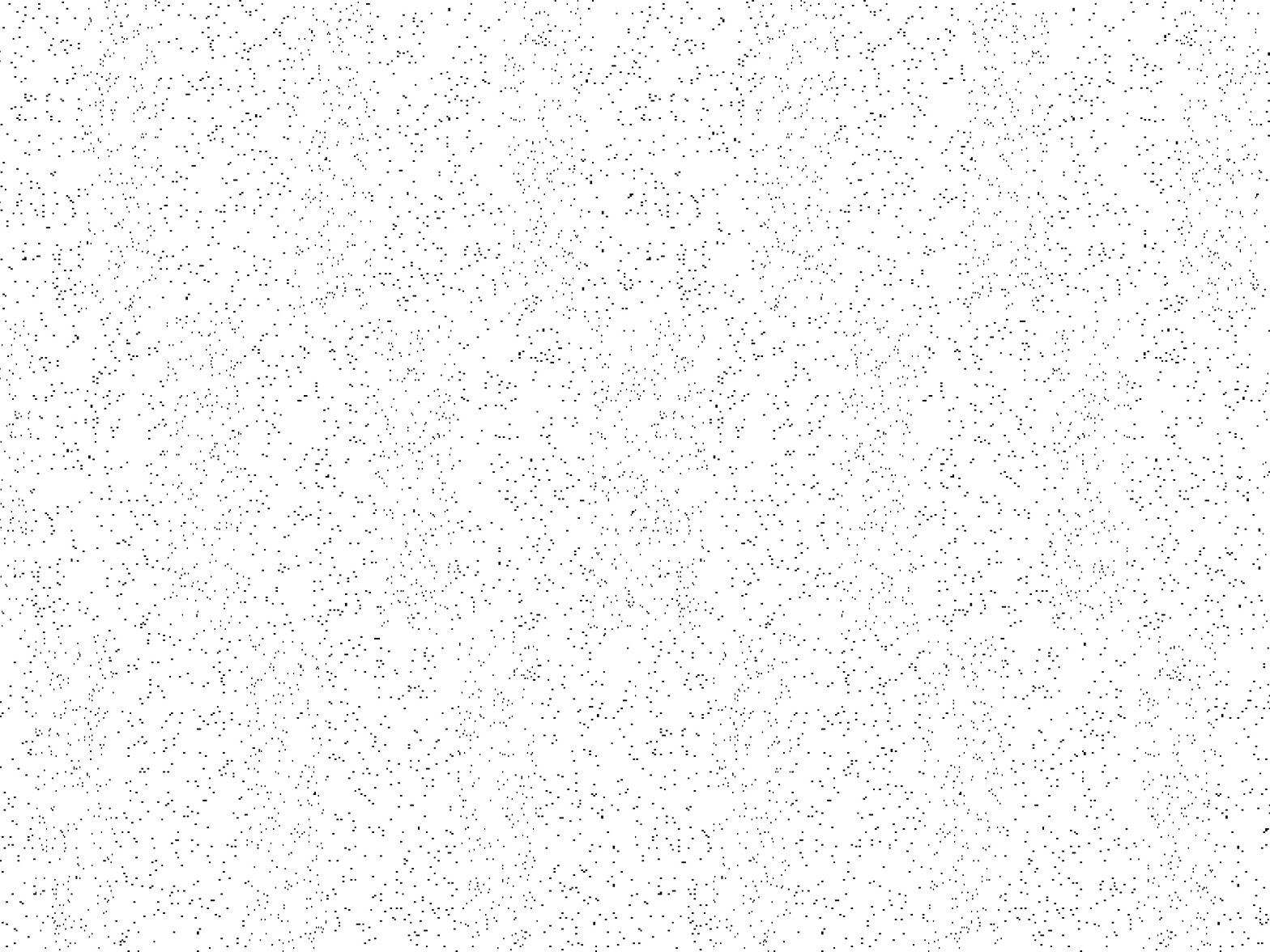
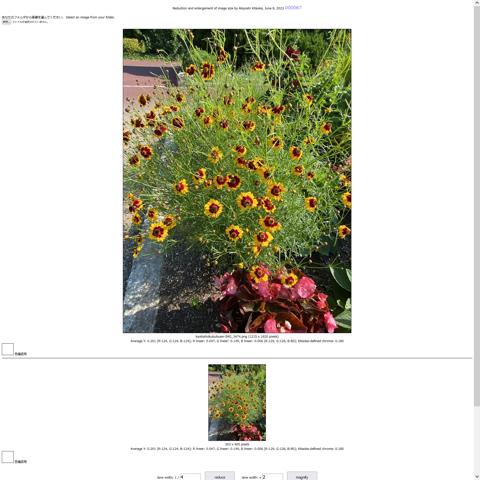
薄氷ドリフト錯視は、細かいテクスチャのある画像なら、どんな画像からでも作成できます。作ってみましょう!
<作成デモ用の画像>

作成用のプログラム
(JavaScript-KDEwave05b-sakkakuWS2026d.html)
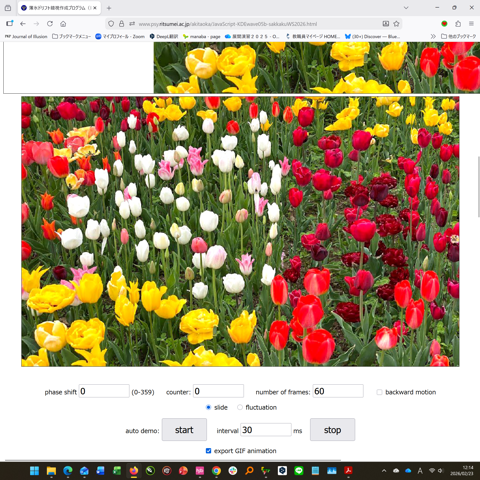
作成例 hakuhyo_drift-tulip-IMG_5002p01-.gif
便利ツール
サンプル画像
https://www.psy.ritsumei.ac.jp/akitaoka/sample_images.html
2ページ目に続く
to be continued
<抄録>
波は、エネルギーや情報が空間を通じて伝播する現象であり、物質の移動を伴わずに振動や変化が広がる。波は、媒質の粒子がそれぞれの平衡位置を中心に振動することで形成される。波が進行する方向と粒子の振動する方向の相対的関係によって、波は縦波(粒子の振動方向が波の進行方向と同じ。疎密波)と横波(粒子の振動方向が波の進行方向と直交)に分類される。本講演では、任意の画像を媒質として用いた計算論的な波のシミュレーションをデモするとともに、それらのシミュレーションの作成の過程において新たに発見された「薄氷ドリフト錯視」を報告する。薄氷ドリフト錯視は図地分離現象の一種で、矩形波の縦波において観察され、波の進行方向に動く粒子のグループ(密の部分)が波の進行方向とは反対の方向に動く粒子のグループ(疎の部分)よりも手前に見える現象である。
<Abstract>
Waves are phenomena in which energy or information propagates through space,
spreading vibrations or changes without the movement of matter. Waves form
as particles in a medium vibrate around their equilibrium positions. Depending
on the relationship between the direction of wave propagation and the direction
of particle vibration, waves are classified as longitudinal waves (where
the particle vibration direction is parallel to the wave propagation direction;
compression-rarefaction waves) and transverse waves (where the particle
vibration direction is perpendicular to the wave propagation direction).
This presentation will demonstrate computational wave simulations using
arbitrary images as the medium and report on the newly discovered “Drifting
fragile sheets of ice illusion” found during the creation of these simulations.
This illusion is a type of figure-ground separation phenomenon observed
in rectangular longitudinal waves. It occurs when a group of particles
moving in the wave's direction of propagation (the dense part) appears
closer than a group of particles moving in the opposite direction (the
sparse part).
展示用 薄氷ドリフト錯視メドレー (hakuhyo_drift-medley.mp4 1分44秒 1.05 GB)