授業内トーク 基礎心理学特論
2026年7月15日3限・AC336
「蛇の回転」とフレーザー・ウィルコックス錯視群
北岡明佳 Akiyoshi Kitaoka (Ritsumeikan University, Osaka, Japan) 配布物
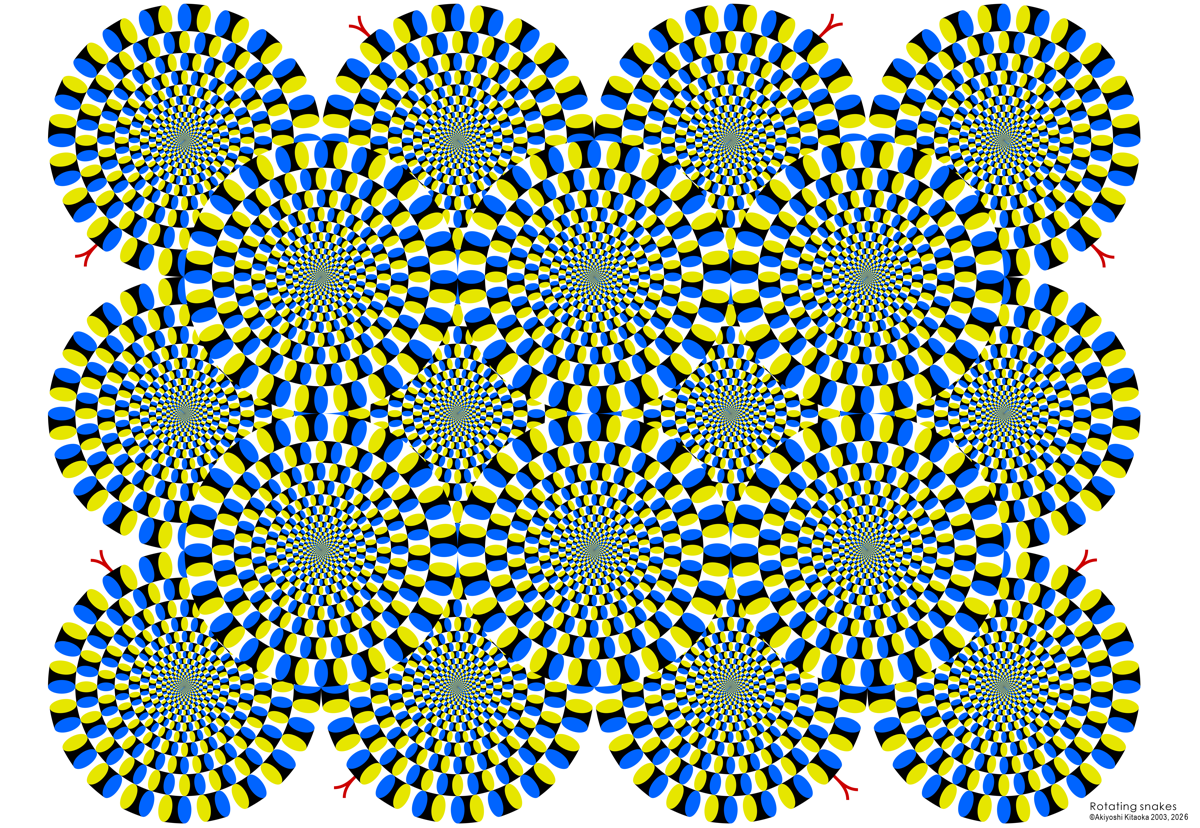
「蛇の回転」"Rotating snakes"
Each disk appears to rotate 'spontaneously' in the constant direction, from black to blue, white, yellow, back to black.
Copyright Akiyoshi Kitaoka 2003 (September 2) (updated June 16, 2026)
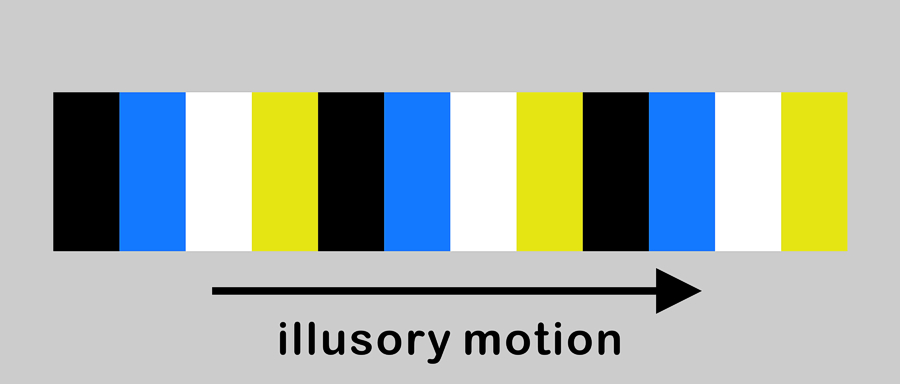
Kitaoka, A. (2014). Color-dependent motion illusions in stationary images and their phenomenal dimorphism. Perception, 43(9), 914-925.
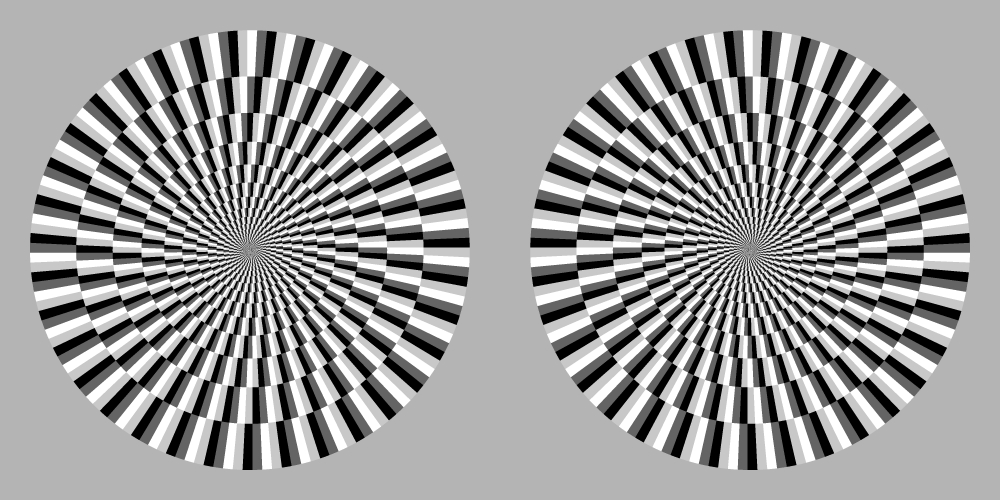
Color is not indispensable. Gray-scale images also work.
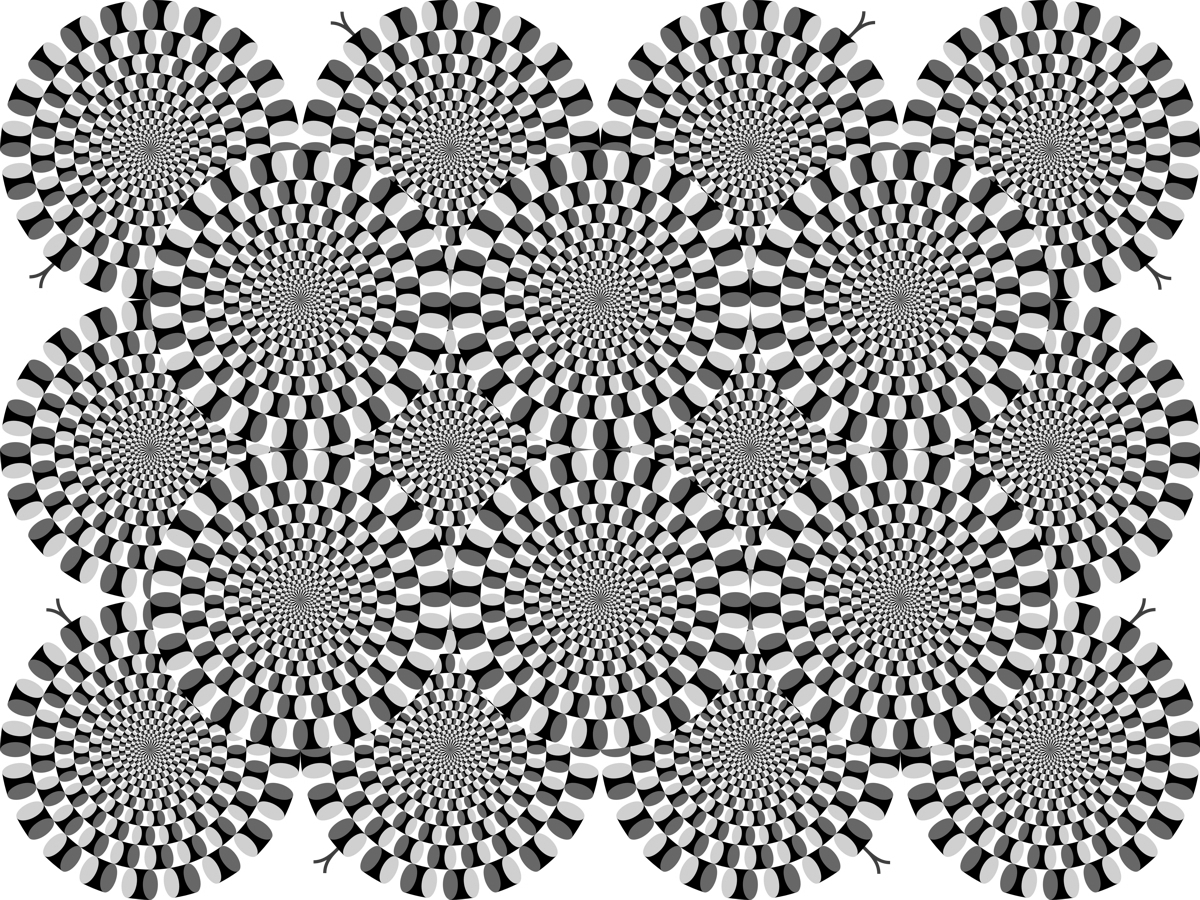
"Rotating snakes: a gray scale version"
Each disk appears to rotate 'spontaneously' in the constant direction, from black to dark gray, white, light gray, back to black.
Copyright Akiyoshi Kitaoka 2013 (May 27)
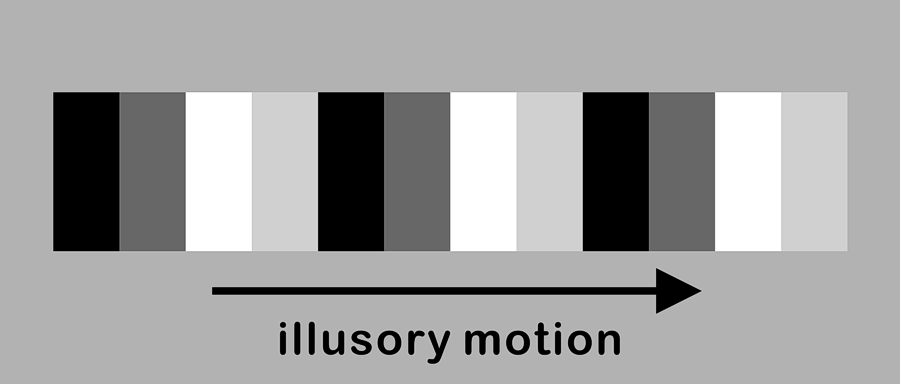
●色付きの方が錯視の強さが少し大きい。
Uesaki, M., Biswas, A., Ashida, H., & Maus, G. (2024). Blue-yellow combination enhances perceived motion in Rotating Snakes illusion. I-Perception, 15(2). https://doi.org/10.1177/20416695241242346
「蛇の回転」制作の経緯
1999年(平成11年)に制作した年賀状の錯視デザインに、この静止画が動いて見える錯視を過去の研究とは独立に発見した。
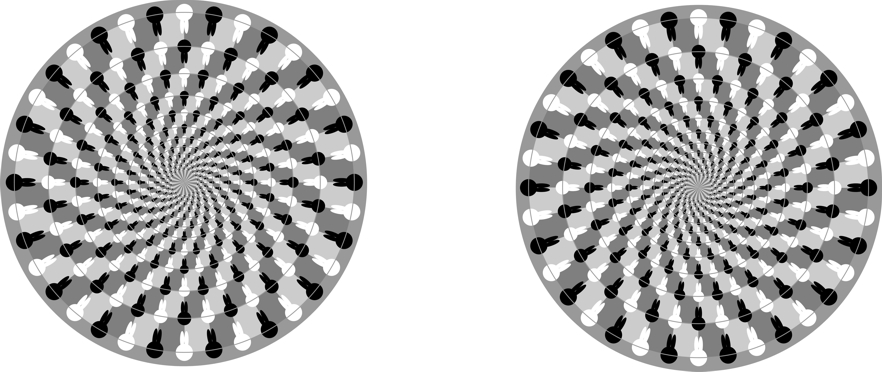
「卯図」
(リメーク版)
円盤が回転して見える。もともとは、灰色の同心円が渦巻きに見えるという渦巻き錯視図形として作られた。年賀状デザイン
Copyright A.Kitaoka 2005 (May 23)
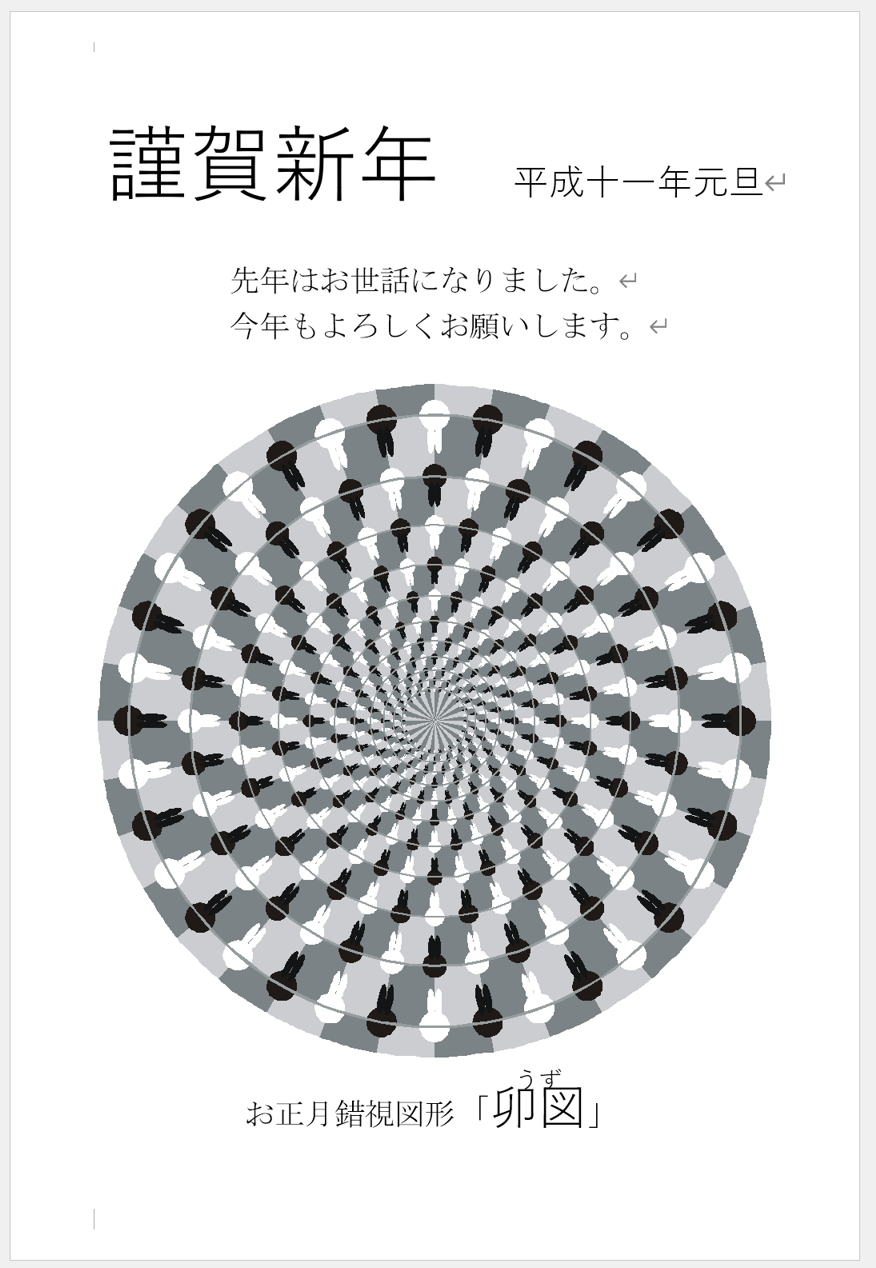
「卯図」は、傾き錯視(を用いた渦巻き錯視)のデモ
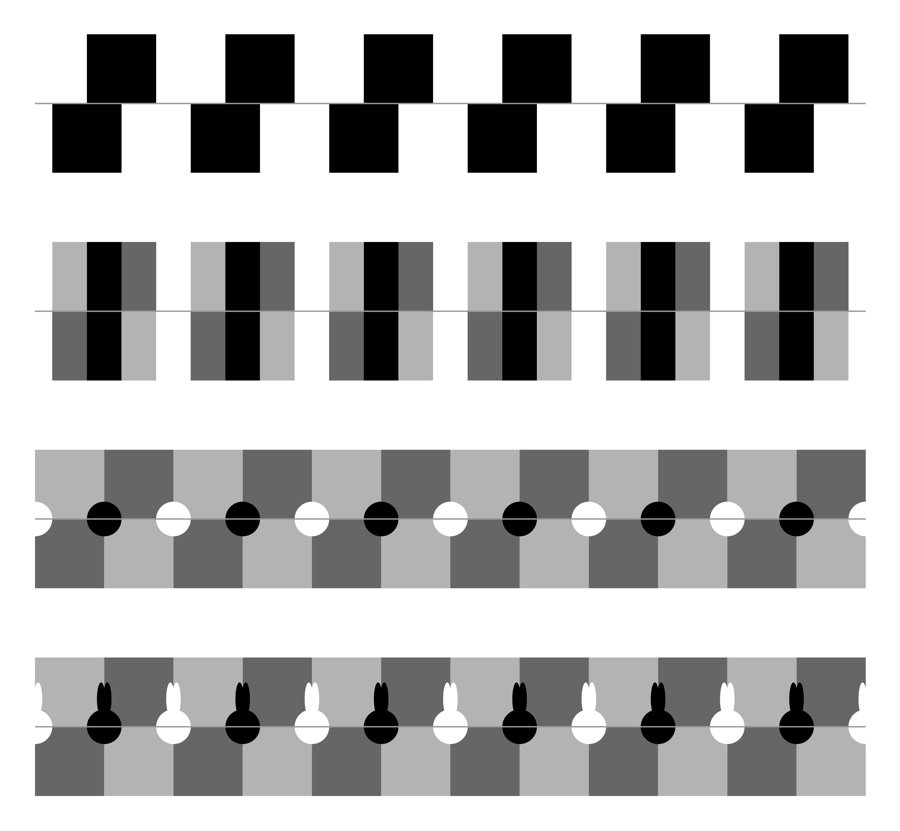
4つの図形の中に引かれている灰色の線はどれも水平だが、時計回りに傾いて見える。一番上:ミュンスターベルク錯視(カフェウォール錯視)、一番下:卯図の傾き錯視
「卯図」で見出された静止画が動いて見える錯視をアップデート
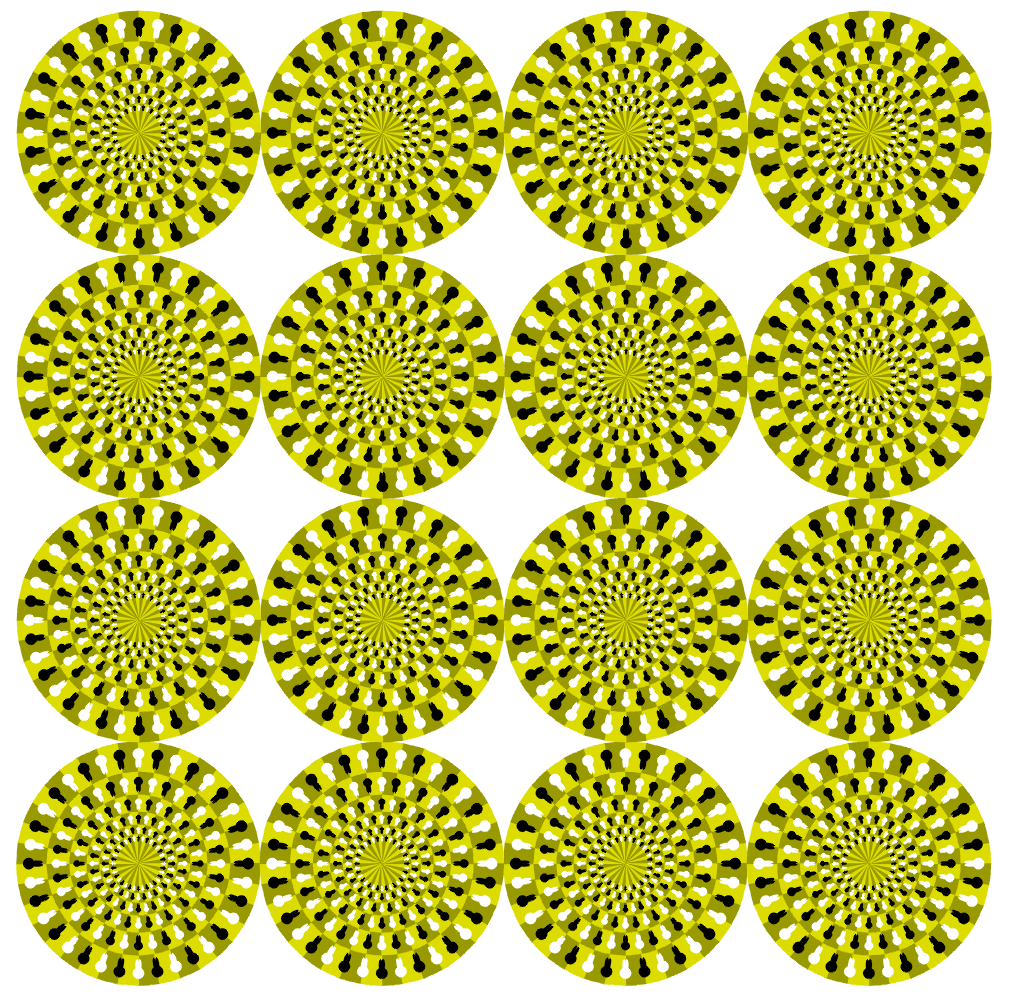
「卯図巻き」
Copyright A.Kitaoka 2003
(c)北岡明佳 2003 「トリックアイズ2」 (カンゼン刊)
これが最初のバージョン
この図形は「トリックアイズ2」の目玉とするためホームページにアップロードしていなかったのですが、トリックアイズ2の裏表紙の写真に人気が出てしまい、盗作騒動が発生するなどの混乱を招きましたので、ちゃんとホームページにのせることにしました。
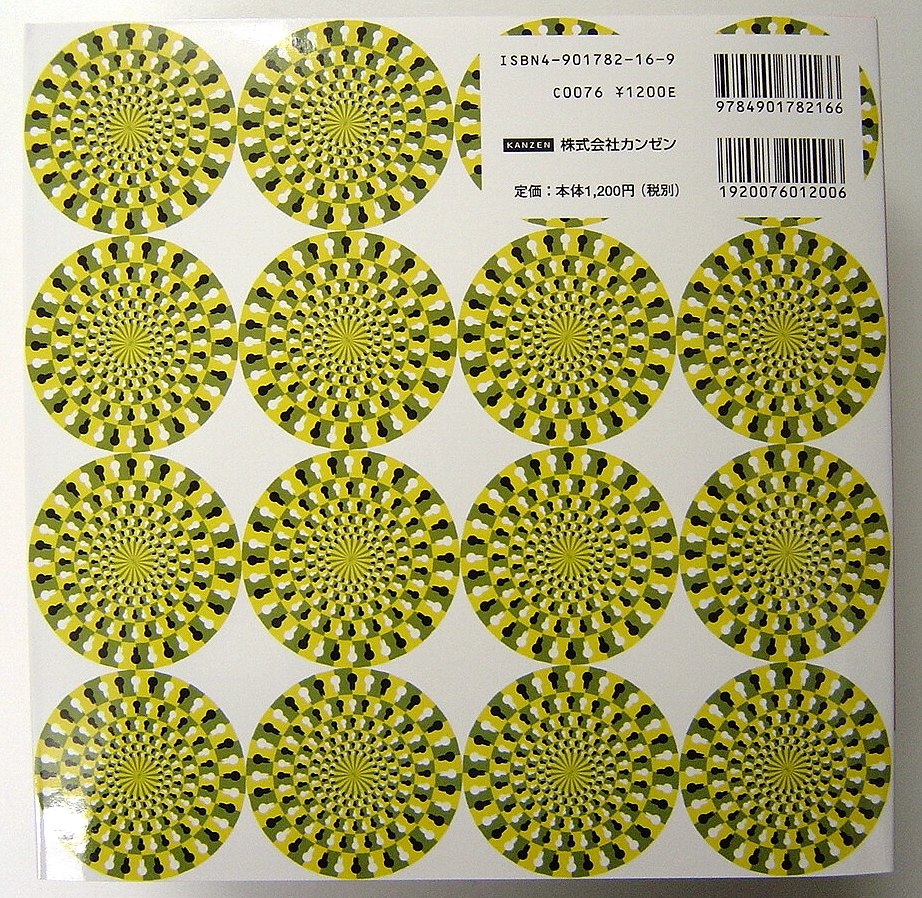
「卯図」で見出された静止画が動いて見える錯視の基本パターンを明確化
Kitaoka, A. and Ashida, H. (2003) Phenomenal characteristics of the peripheral drift illusion. VISION (Journal of the Vision Society of Japan), 15, 261-262. PDF
日本視覚学会での発表の様子
日本視覚学会2003年夏季大会・神奈川県葉山町湘南国際村センター・2003年7月21日~23日
発表日は7月21日、ポスター発表のタイトルは「周辺視ドリフト錯視の現象的特性」(PDF file)、デモ企画(写真)のタイトルは「動く錯視はこんなに危ない」
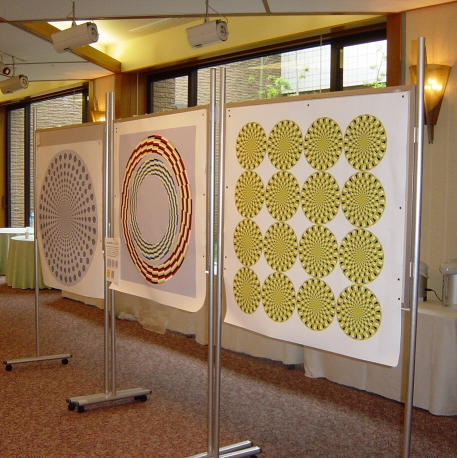
立命館大学文学部心理学科では大型プリンタを導入し、いろいろ研究中です。
Acknowledgement. This research was supported by Grant-in-Aid for Scientific Research (No. 14310045) awarded from the Japan Society for the Promotion of Science, and Project Research B (2002-2004) awarded from the Institute of Human Sciences, the Ritsumeikan University.
「卯図巻き」をさらに単純化・最適化して、2003年に「蛇の回転」が誕生
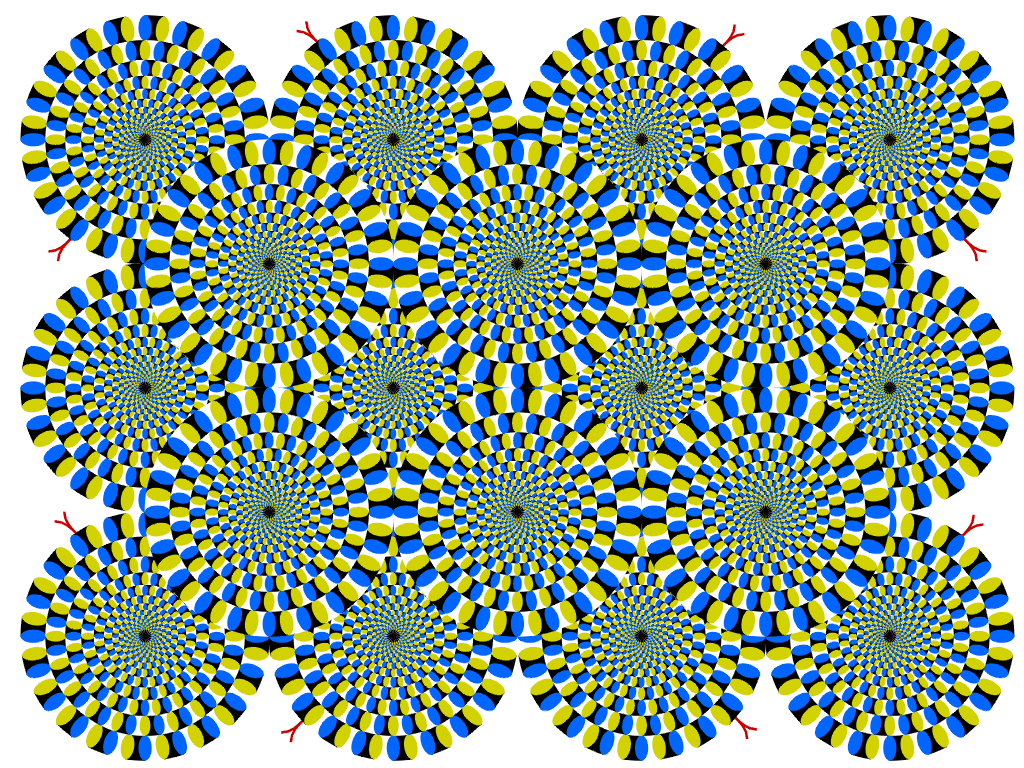
「蛇の回転」
勝手に回転して見える。
Copyright A.Kitaoka 2003 (September 2, 2003)
1024 × 768 ピクセル
「北岡明佳の錯視のページ」のトップページに掲載

人気を博した(バズった)ので、2026年現在まで、そのまま飾ってある。
「蛇の回転」を発表した頃には、類似した錯視が既に報告されていることに気づいた。
Fraser and Wilcox showed a new phenomenon that stationary disks appear to rotate. They reported bimorphism or bistability of this illusion.
1. Fraser and Wilcox (1979)
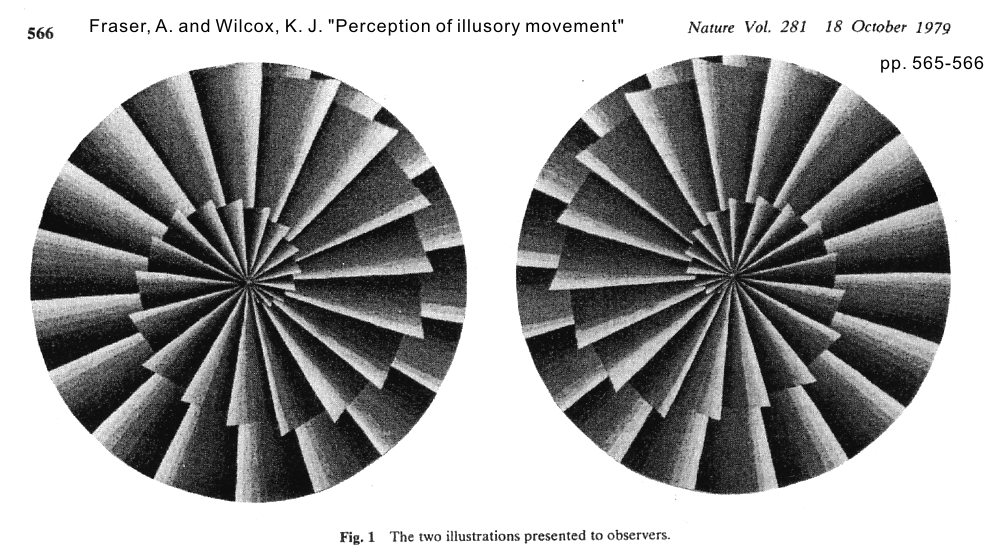
Fraser, A. and Wilcox, K. J. (1979). Perception of illusory movement. Nature, 281, 565-566. https://doi.org/10.1038/281565a0
Ambiguity in the direction of illusory rotation

Alex Fraser was a professor of genetics and a painter!
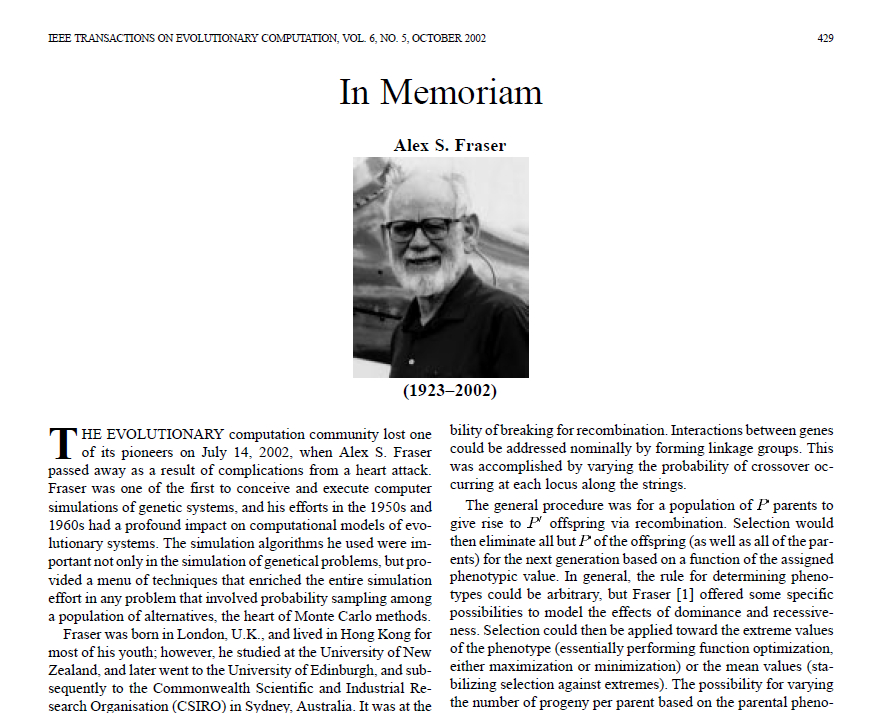
Fogel, D. B. (2002). In Memoriam: Alex S. Fraser (1923–2002). IEEE Transactions on Evolutionary Computation, 6(5), 429-430.

Alex Fraser's original work
Adopted with permission from Alan Fraser (2006) "Alex Fraser, Geneticist and Painter" http://doctoralexfraser.blogspot.jp/
The perceptual bimorphism proposed by Fraser and Wilcox (1979) was not replicated for subsequent two decades.
2. Faubert and Herbert (1999)
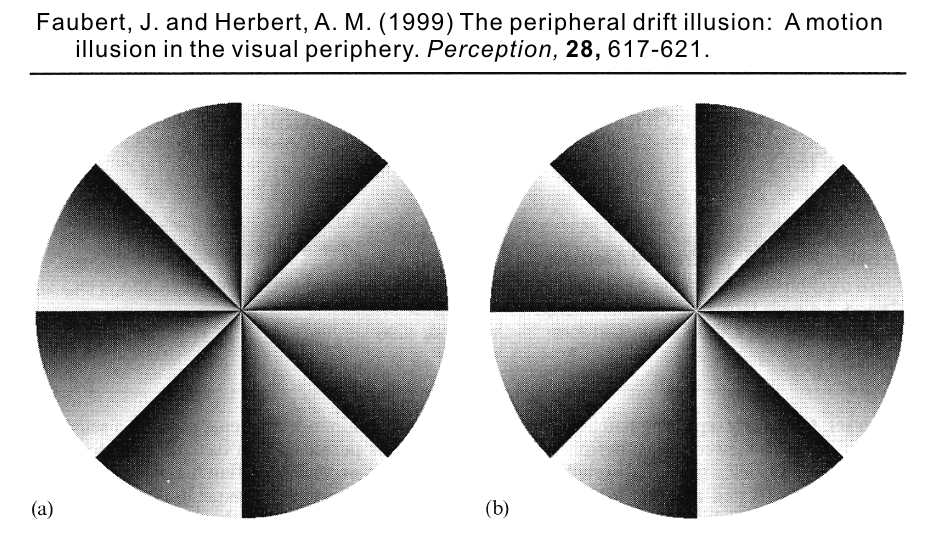
Faubert, J. and Herbert, A. M. (1999) The peripheral drift illusion: A motion illusion in the visual periphery. Perception, 28, 617-621.

3. Naor-Raz and Sekuler (2000)
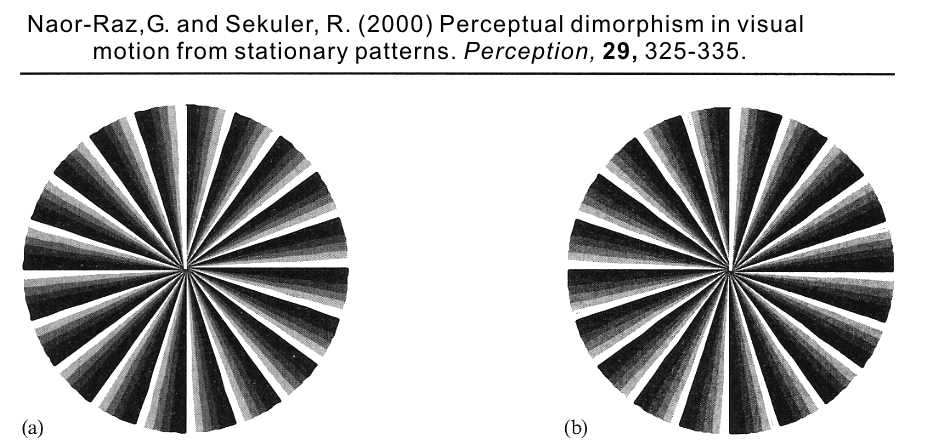
Naor-Raz, G. and Sekuler, R. (2000) Perceptual dimorphism in visual motion from stationary patterns. Perception, 29, 325-335.

We separated two illusions that cancel each other and proposed the optimized Fraser-Wilcox illusion.
Kitaoka, A. and Ashida, H. (2003) Phenomenal characteristics of the peripheral drift illusion. VISION (Journal of the Vision Society of Japan), 15, 261-262. PDF
Two illusion are cooperatively combined.
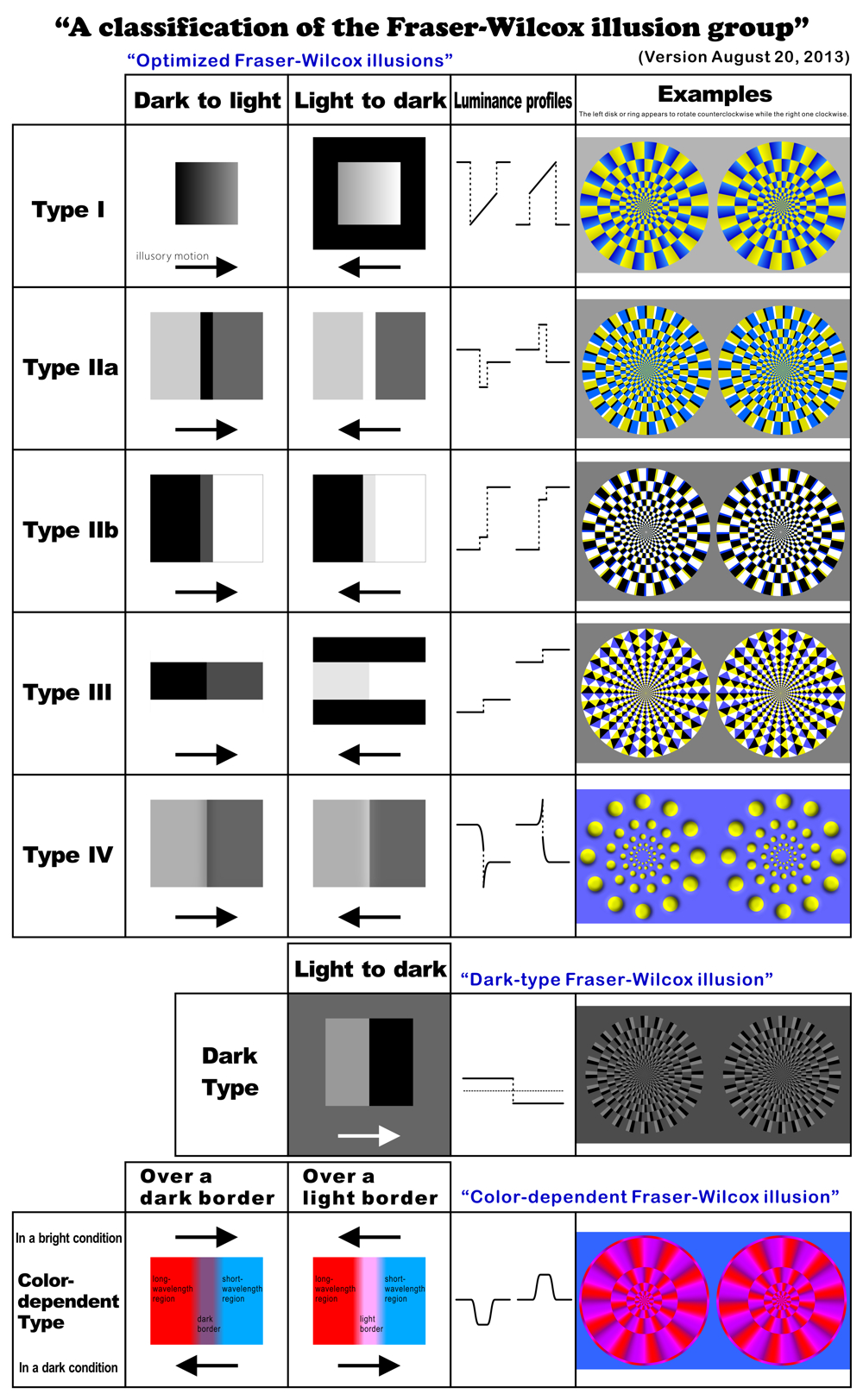
There are a few types of the optimized Fraser-Wilcox illusion.
Luminance gradient type (Type I)
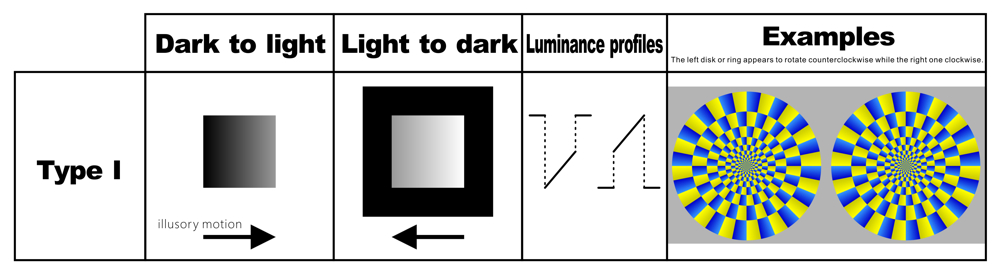
The left disk appears to rotate counterclockwise while the right one clockwise.
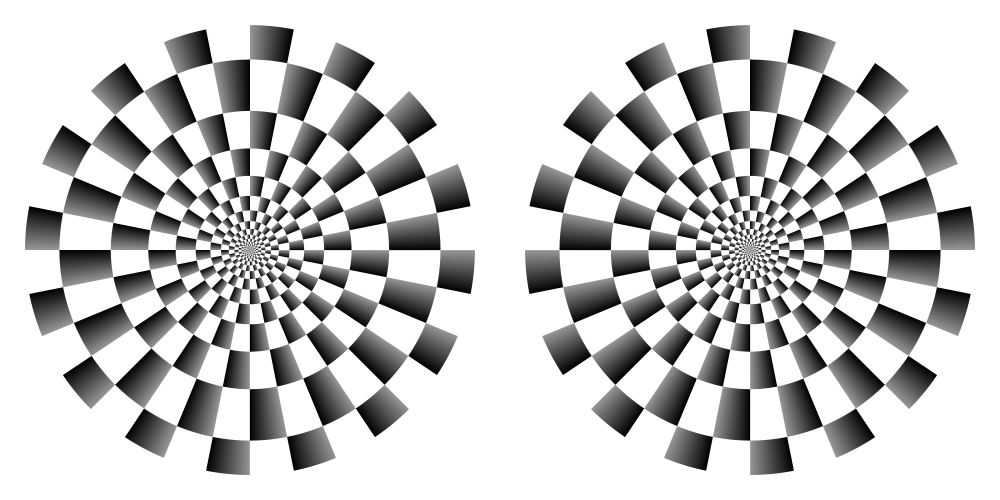
"Dark to light"

"Light to dark"
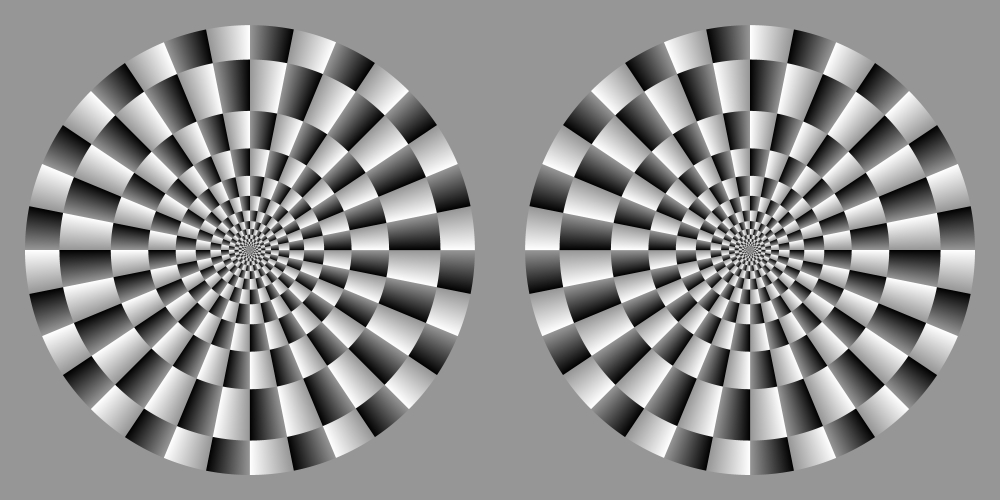
"Dark to light" and "Light to dark"
are combined, giving a stronger illusion
Color enhances illusion.
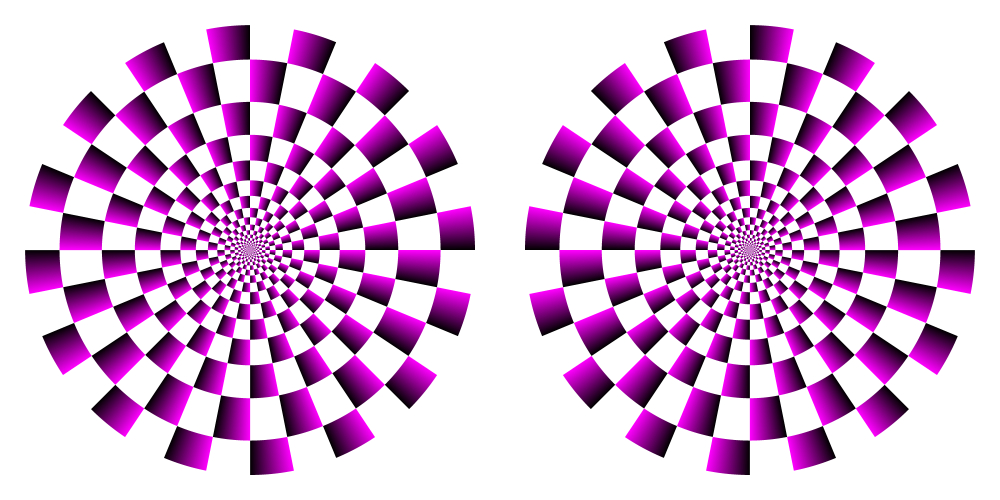
The illusion from dark to light is enhanced by red or blue.
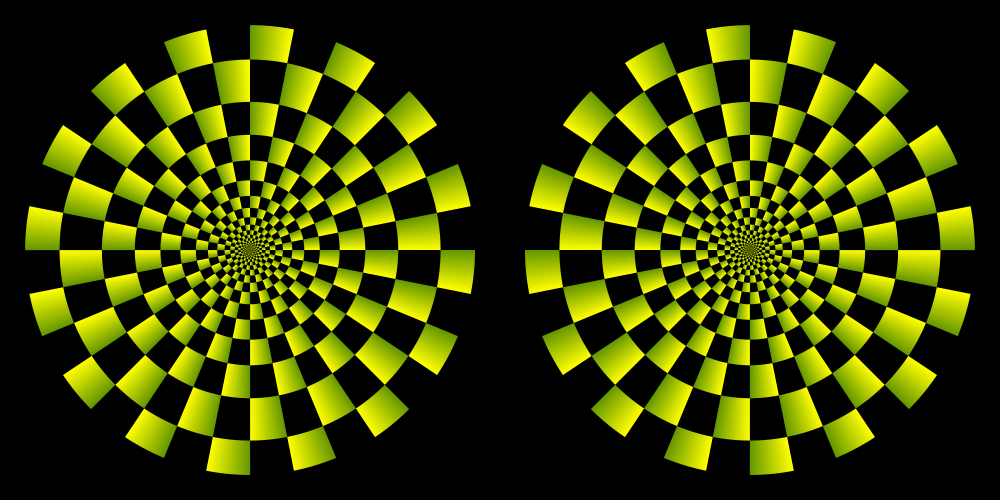
The illusion
from light to dark is enhanced by yellow or green.
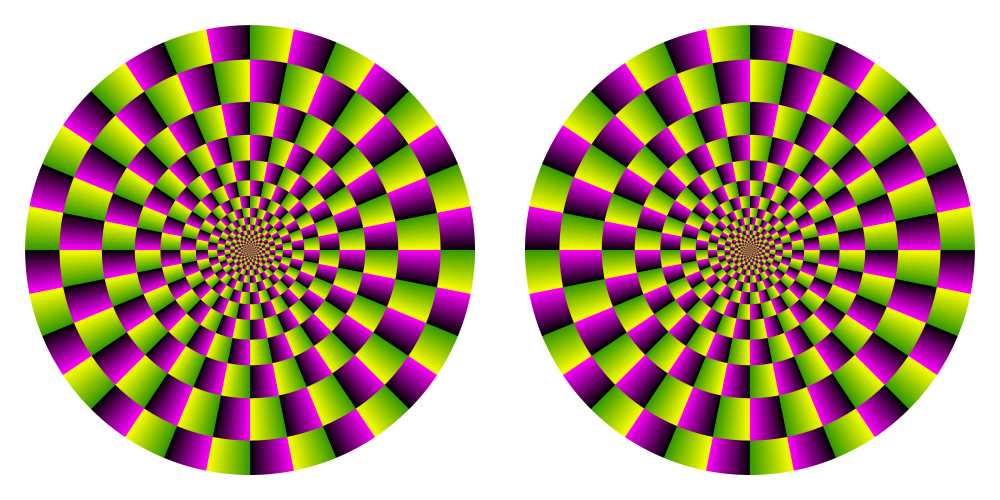
Both illusions work additively.
<Example> The upper-left, upper-right, and lower-middle disks appear
to rotate counterclockwise while the rest clockwise.
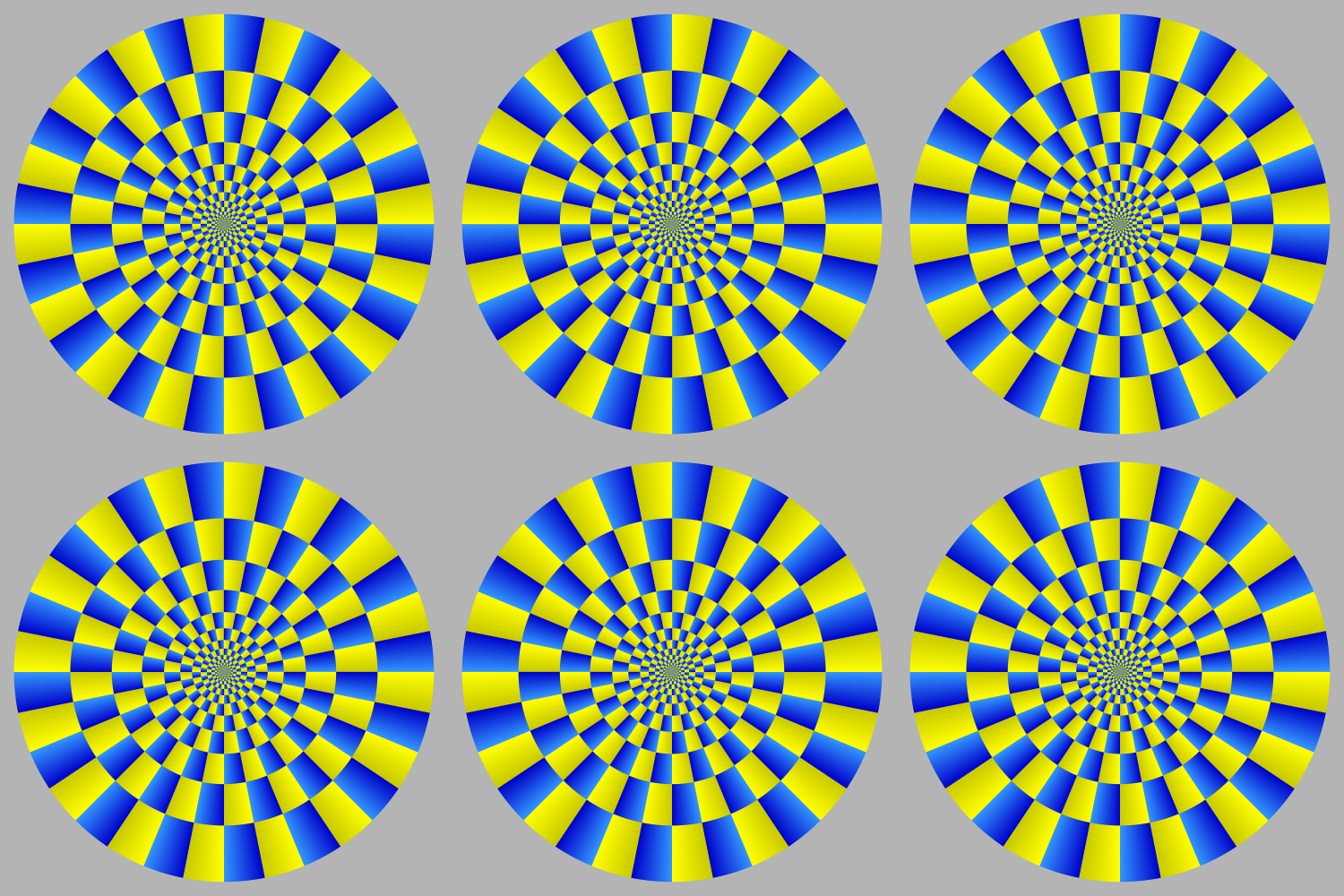
Luminance step type (Type II)
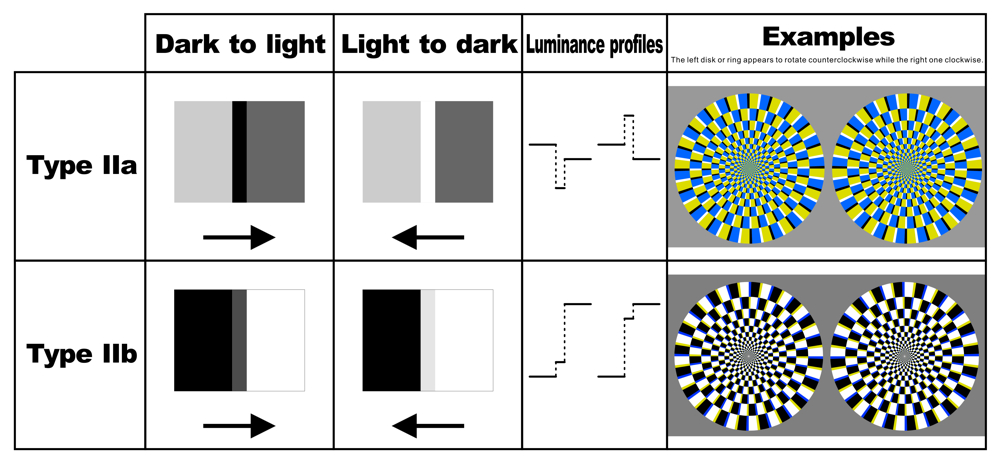
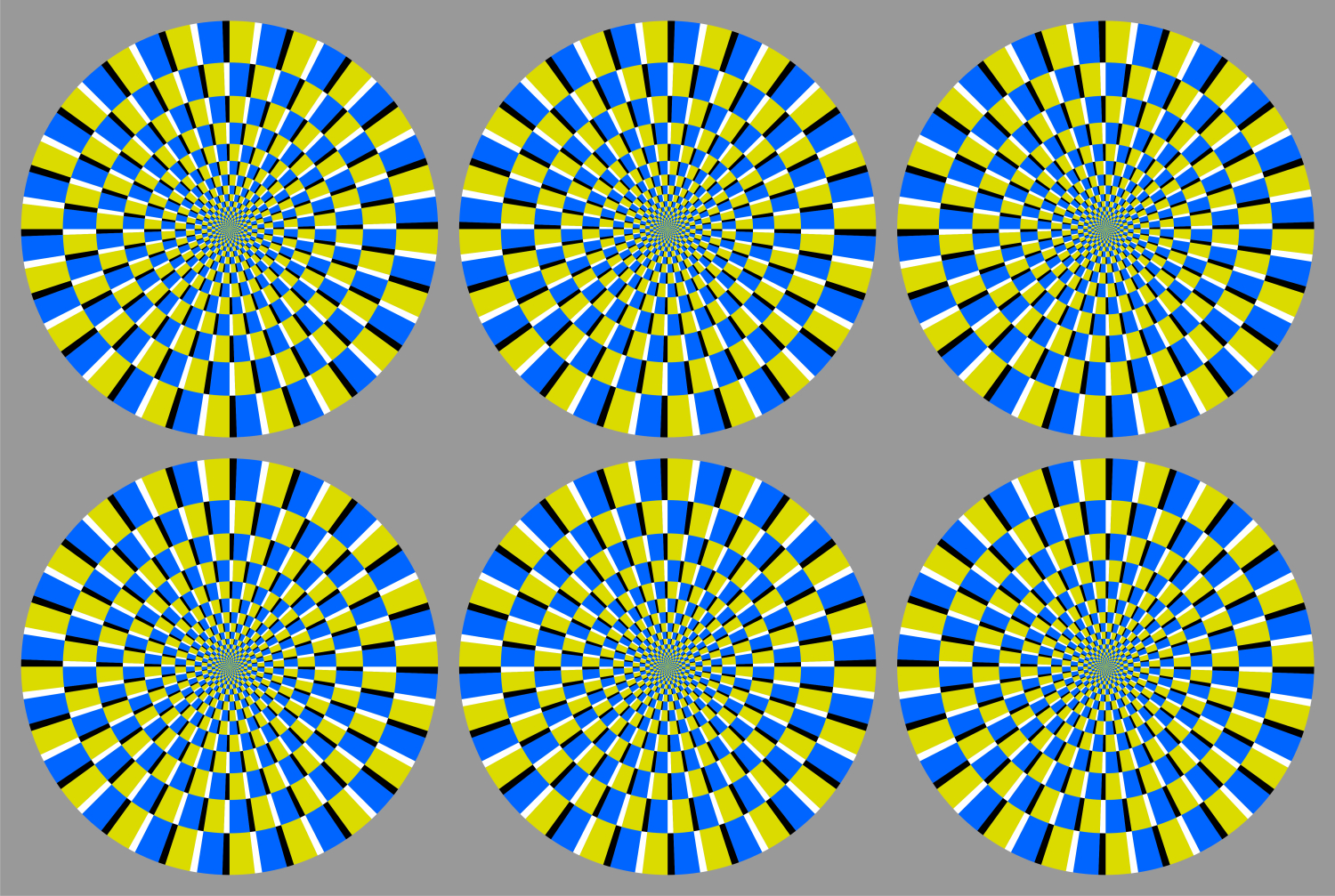
<Example> The upper-left, upper-right, and lower-middle disks appear
to rotate counterclockwise while the rest clockwise.
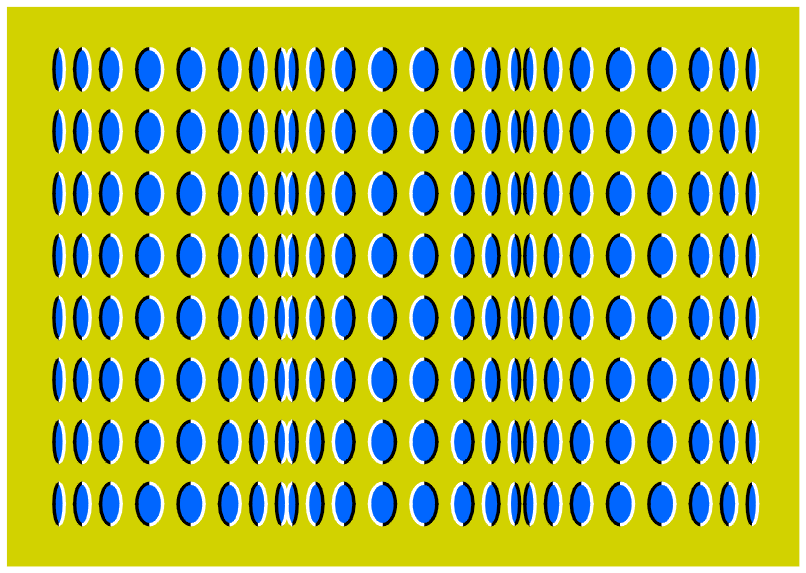
"Rollers"
Rollers appear to rotate without effort. On the other hand, they appear to rotate in the opposite direction when observers see this image keeping blinking.
Copyright A.Kitaoka 2004 (April 20)

"Dongururin"*
*Rotation of donguri (acorns). "Gururin" means rotation.
Rings of donguri appear to rotate.
Copyright A.Kitaoka 2003 (July 3, 2003)
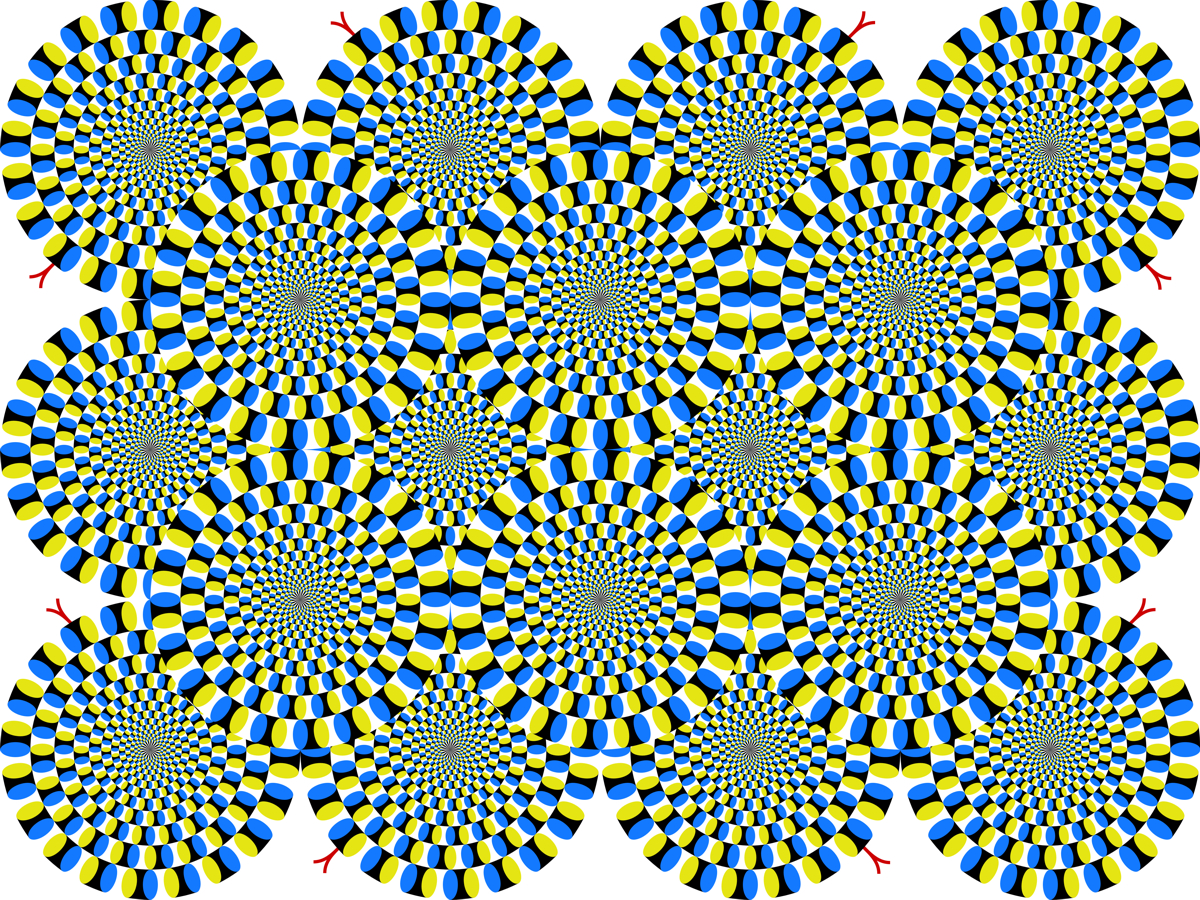
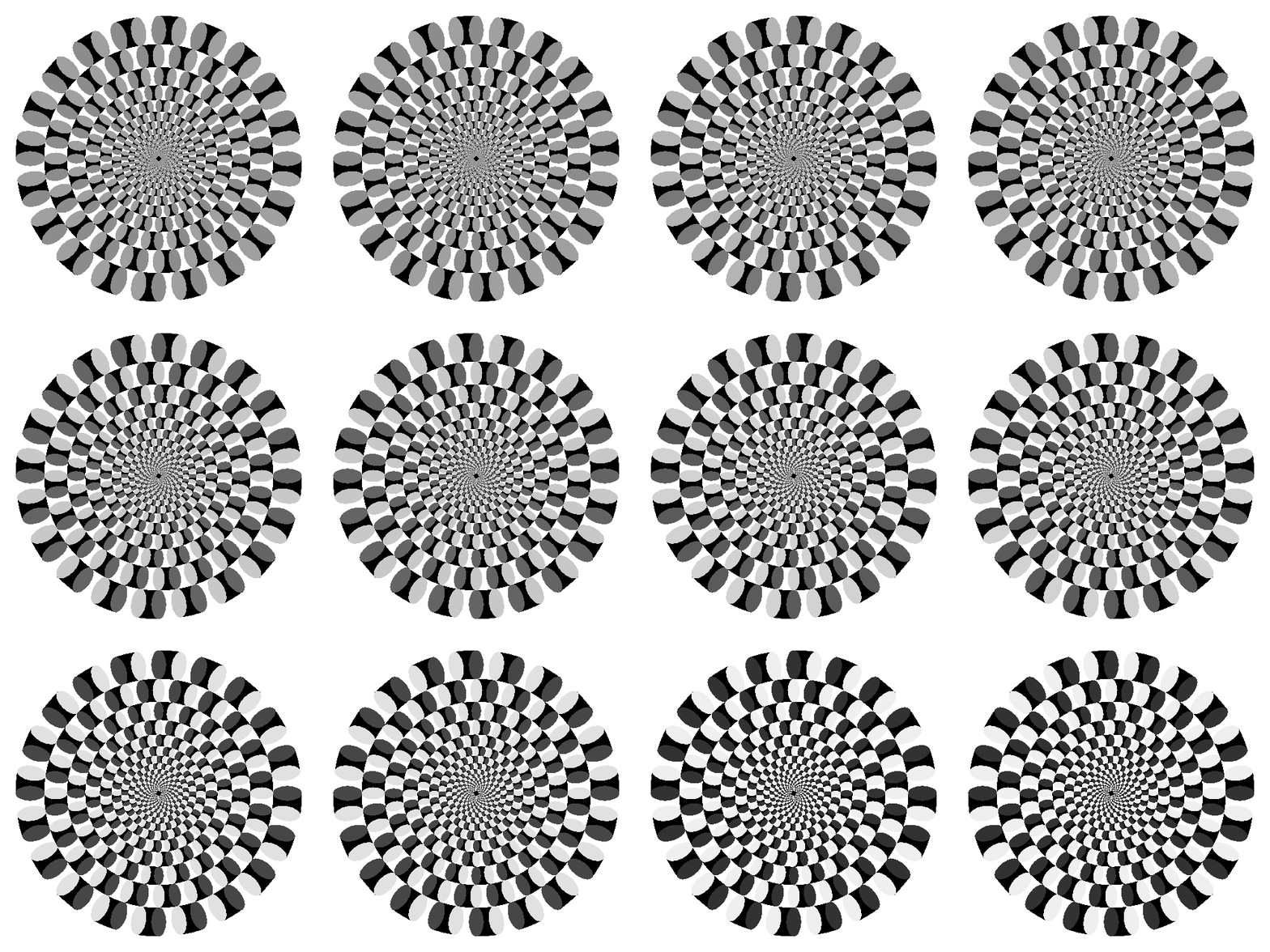
"Rotating snakes"
Each disk appears to rotate 'spontaneously' in the constant direction, from black to blue, white, yellow, back to black.
Copyright Akiyoshi Kitaoka 2003 (September 2) (updated February 16, 2013)
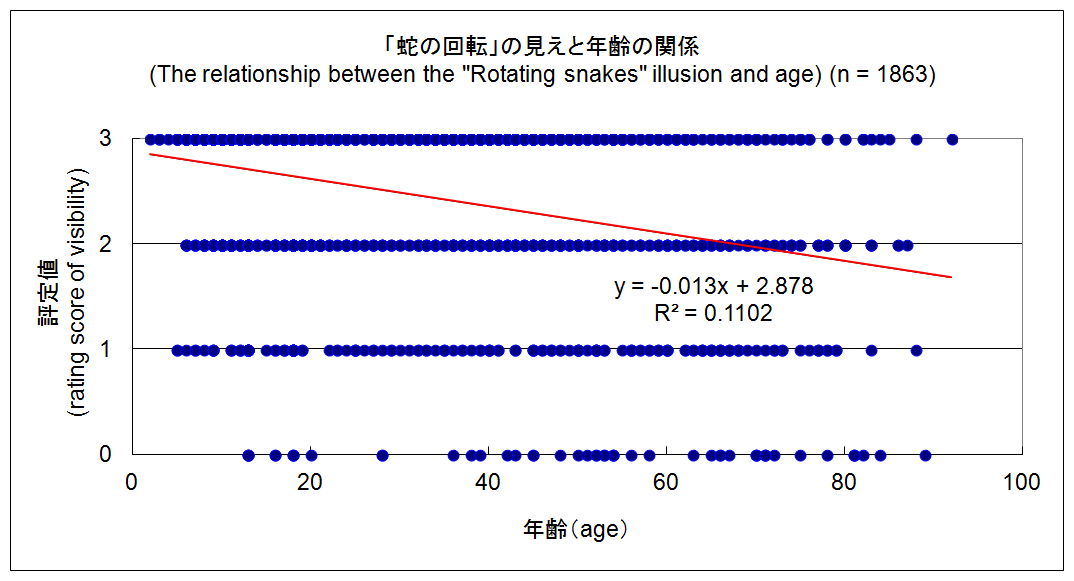
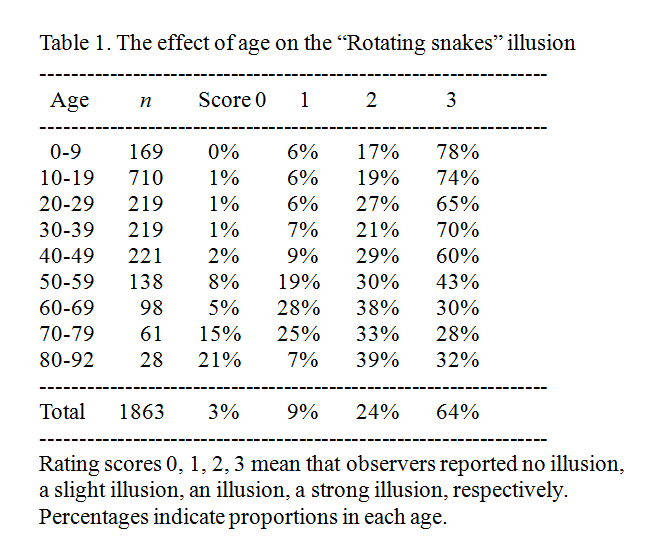
Age and illusion
Another luminance step type (Type III)
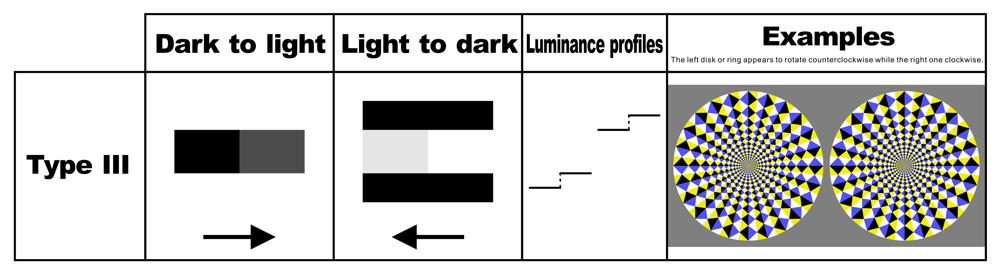
<Example> The upper-left, upper-right, and lower-middle disks appear
to rotate counterclockwise while the rest clockwise.
.jpg)
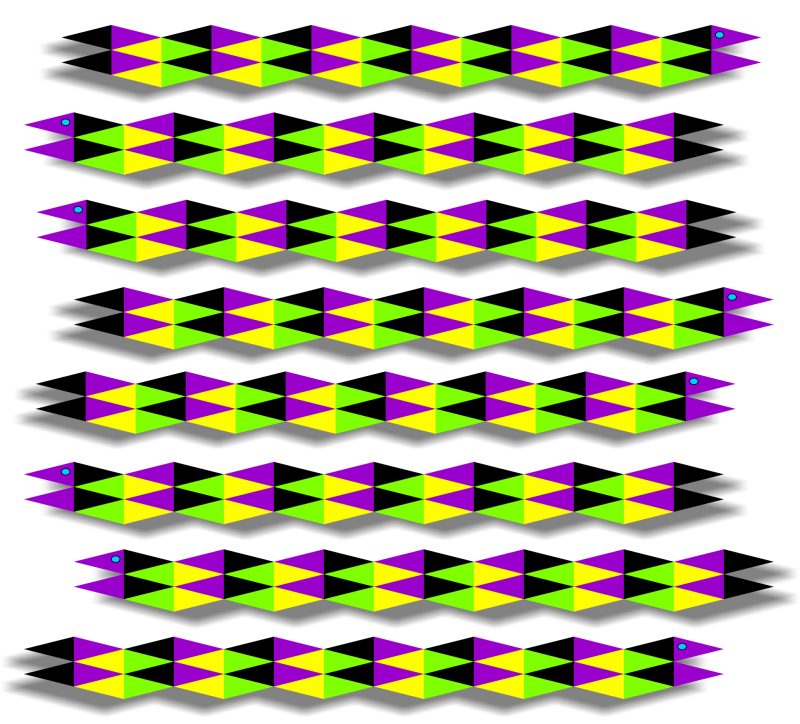
"Moving snakes with shadows"
Snakes appear to move horizontally.
Copyright Akiyoshi Kitaoka 2009 (June 7)
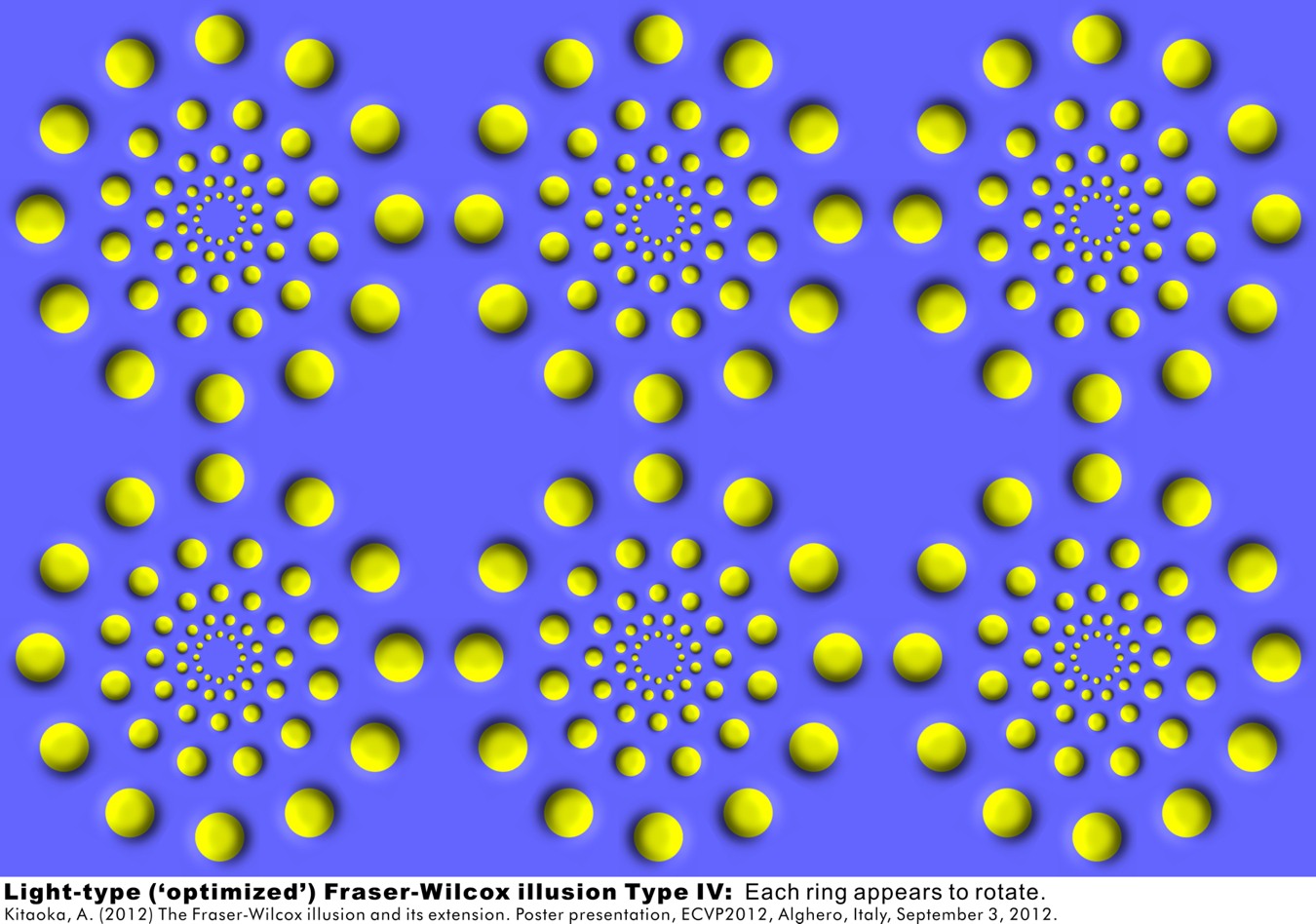
Highlight and shadow type (Type IV)

<Example> The upper-left, upper-right, and lower-middle disks appear
to rotate counterclockwise while the rest clockwise.
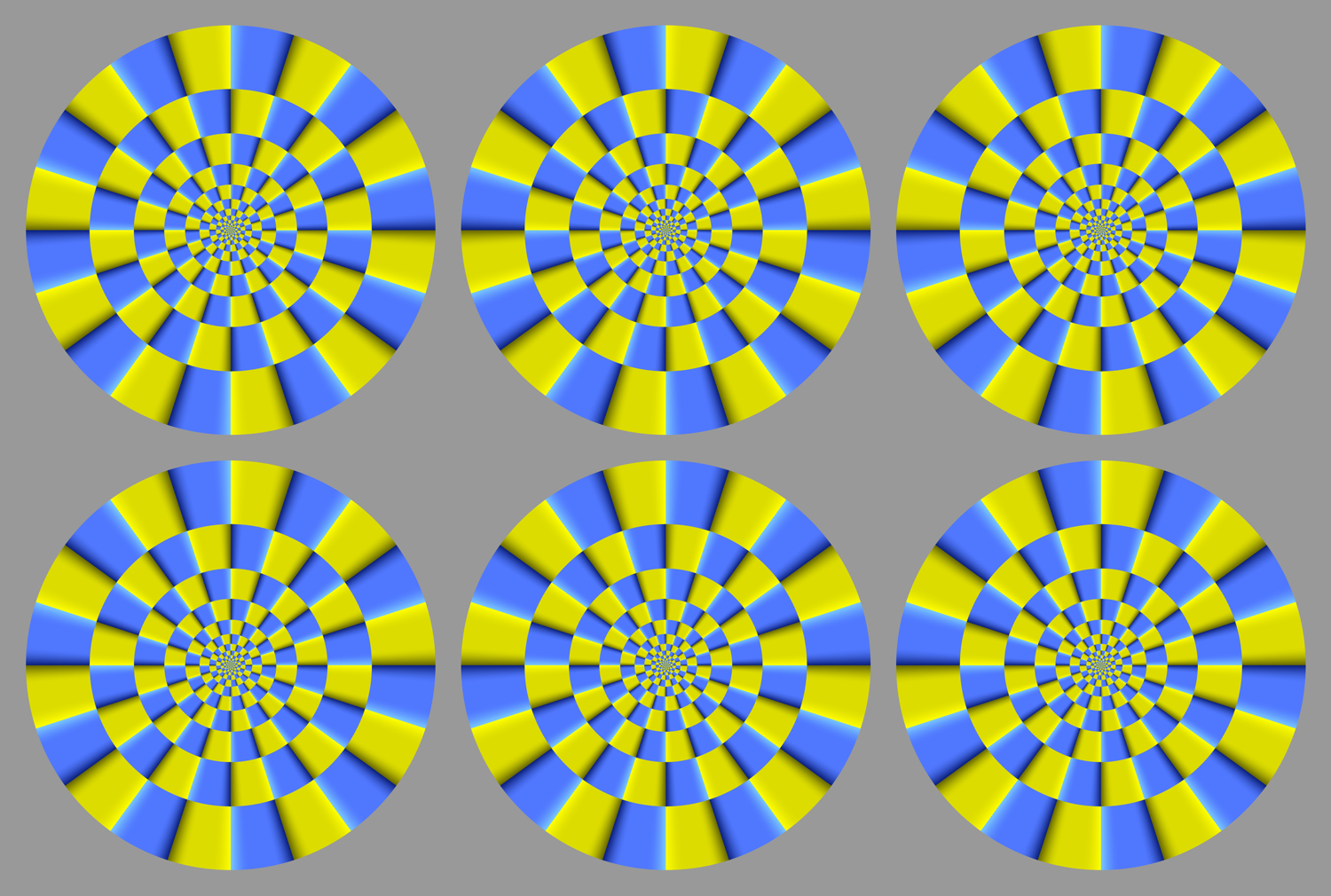
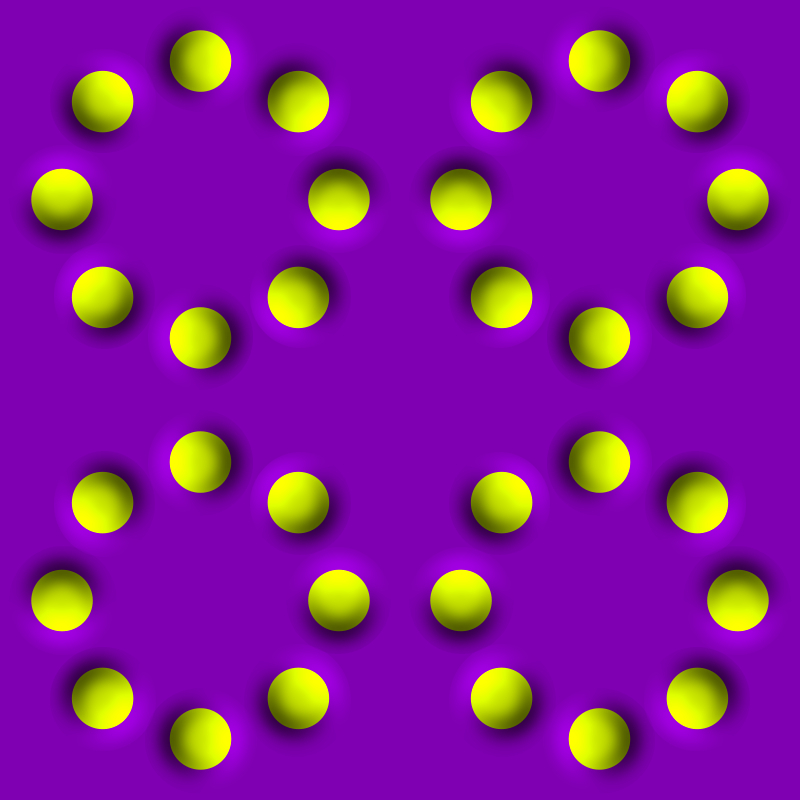
"Rotating tablets"
Rings appear to rotate.
Copyright Akiyoshi Kitaoka 2011 (July 14)
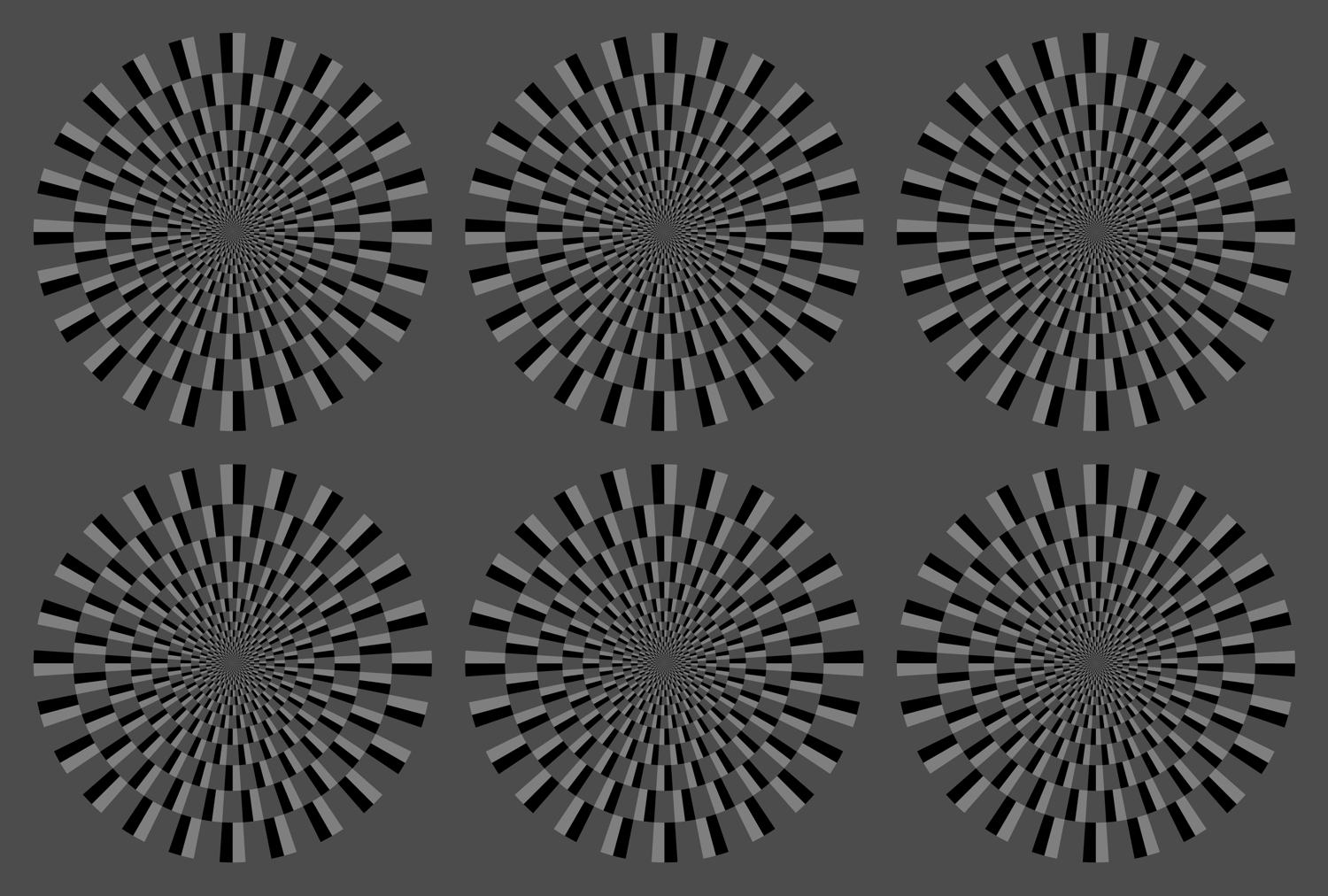
Dark type

<Example> The upper-left, upper-right, and lower-middle disks appear
to rotate counterclockwise while the rest clockwise.
Kitaoka, A. (2012). The Fraser-Wilcox illusion and its extension. Perception 41 ECVP Abstract Supplement, page 91 (Poster September 3, 2012). Poster PDF

Copyright Robert Sekuler
Exception of the dark type
(kind of color-dependent type)
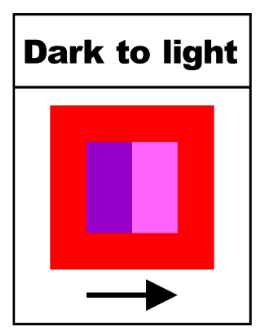

Kitaoka, A. (2012). The Fraser-Wilcox illusion and its extension. Perception 41 ECVP Abstract Supplement, page 91 (Poster September 3, 2012). Poster PDF
A few years ago I discovered the color-dependent motion illusion.
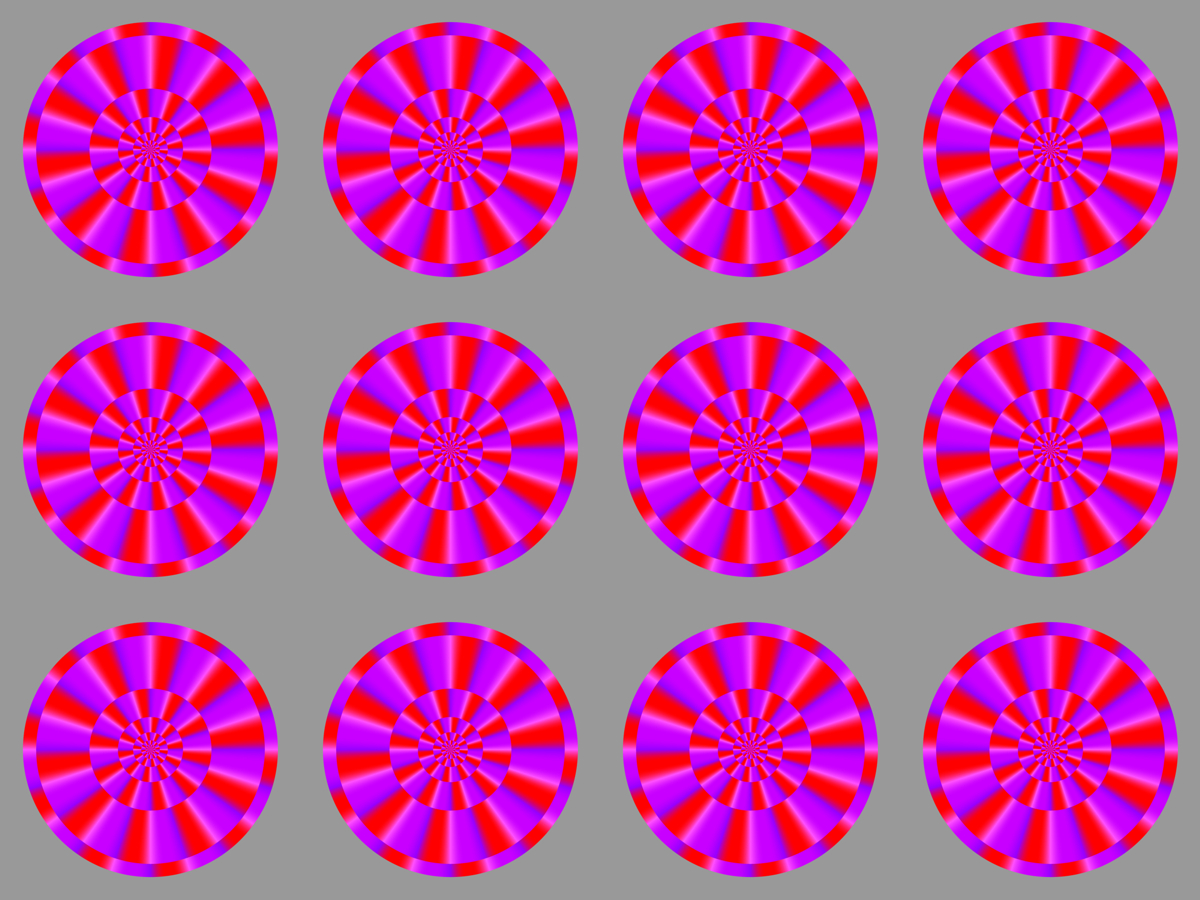
Copyright Akiyoshi Kitaoka 2013 (February 6)
Figure 6 of Kitaoka, A. (2014). Color-dependent motion illusions in stationary images and their phenomenal dimorphism. Perception, 43(9), 914-925.

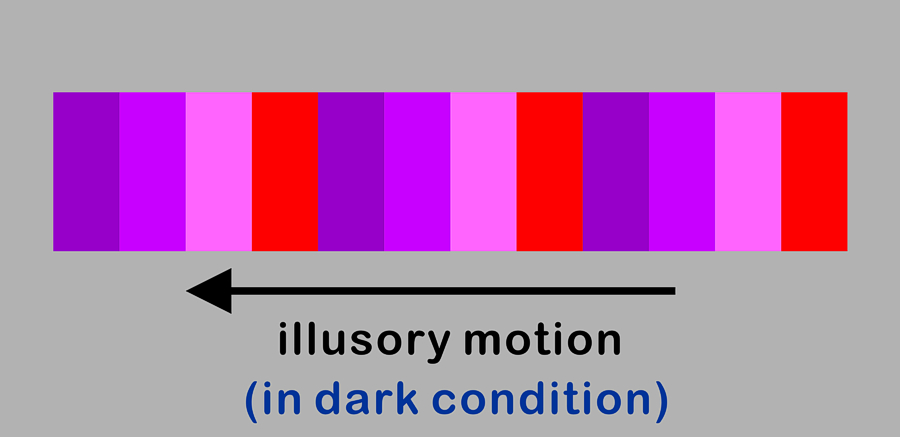
Color-dependent type
(色依存のフレーザー・ウィルコックス錯視)

Kitaoka, A. (2014). Color-dependent motion illusions in stationary images and their phenomenal dimorphism. Perception, 43(9), 914-925. https://doi.org/10.1068/p7706
Nishiakawa, M. & Kitaoka, A. (2026). The effects of color temperature and illuminance on the color-dependent Fraser–Wilcox illusion. i-Perception, 17(1). https://doi.org/10.1177/20416695251412759

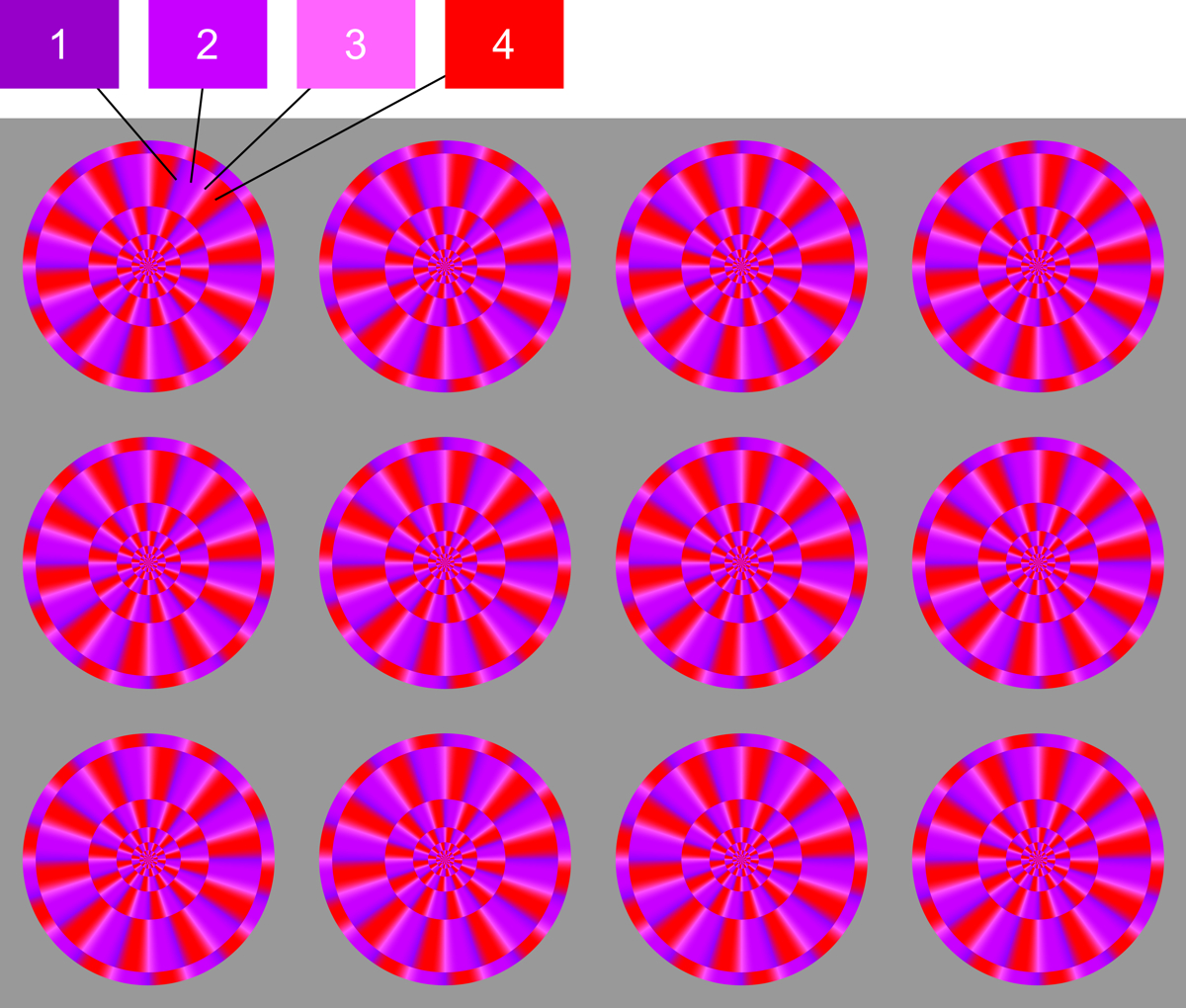
Figure 6 of Kitaoka, A. (2014). Color-dependent motion illusions in stationary
images and their phenomenal dimorphism. Perception, 43(9), 914-925.
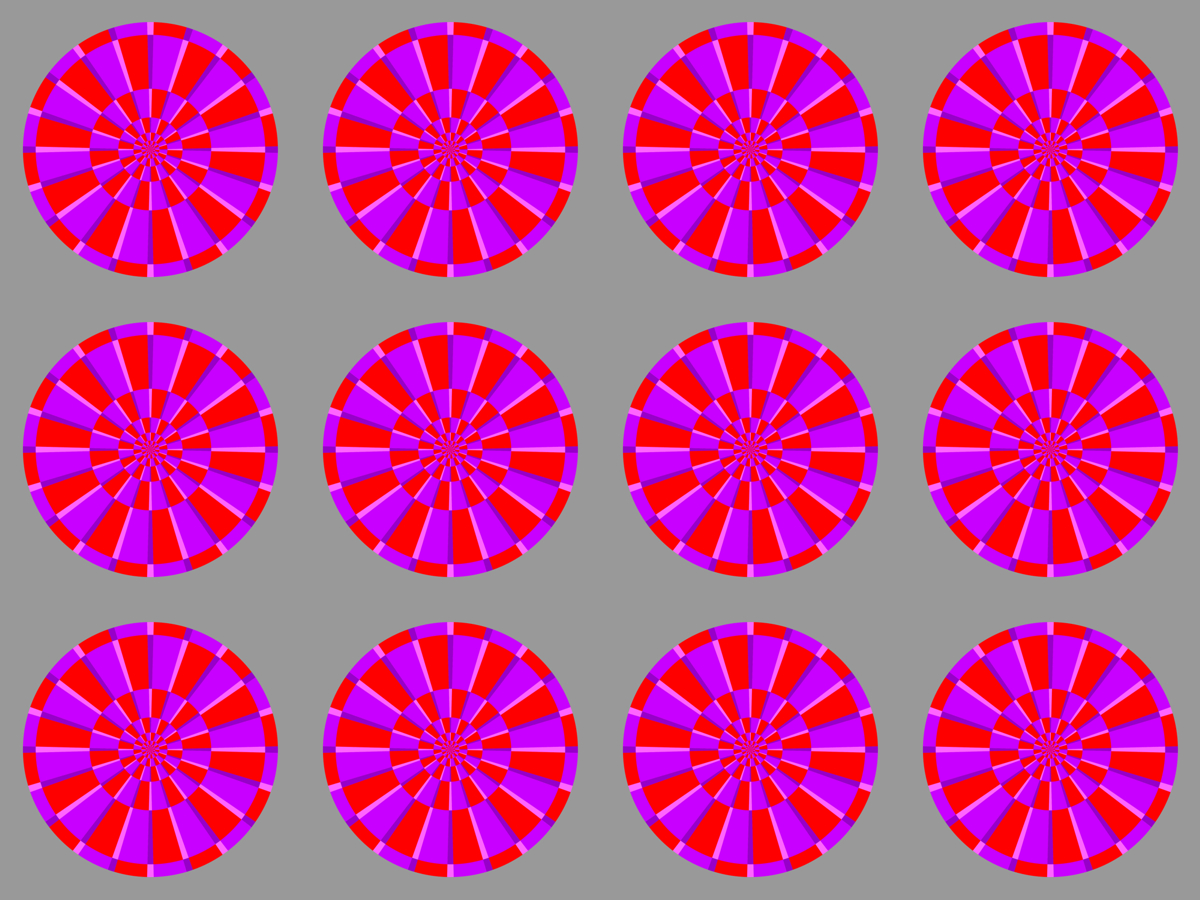
Illusion remains when the image is not blurred.
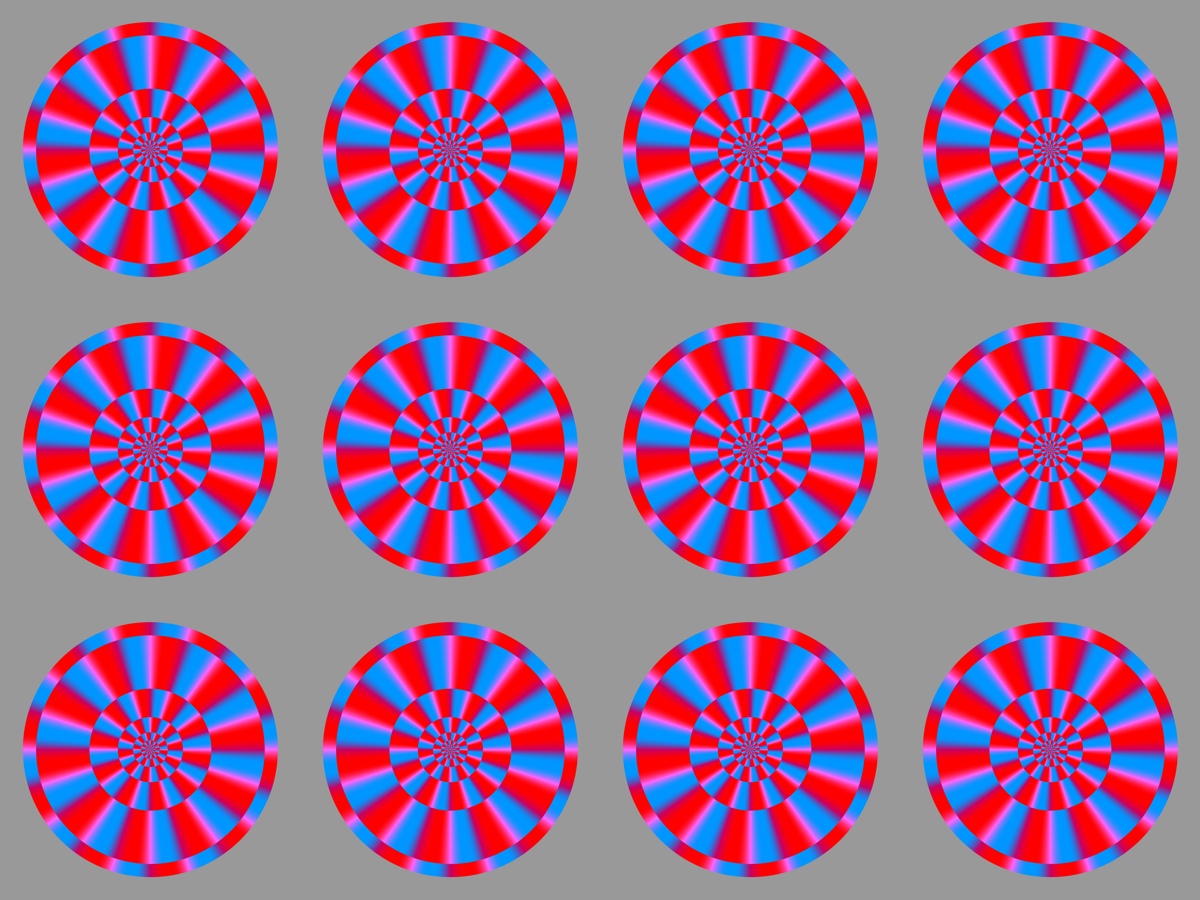
Illusion occurs with red and blue.
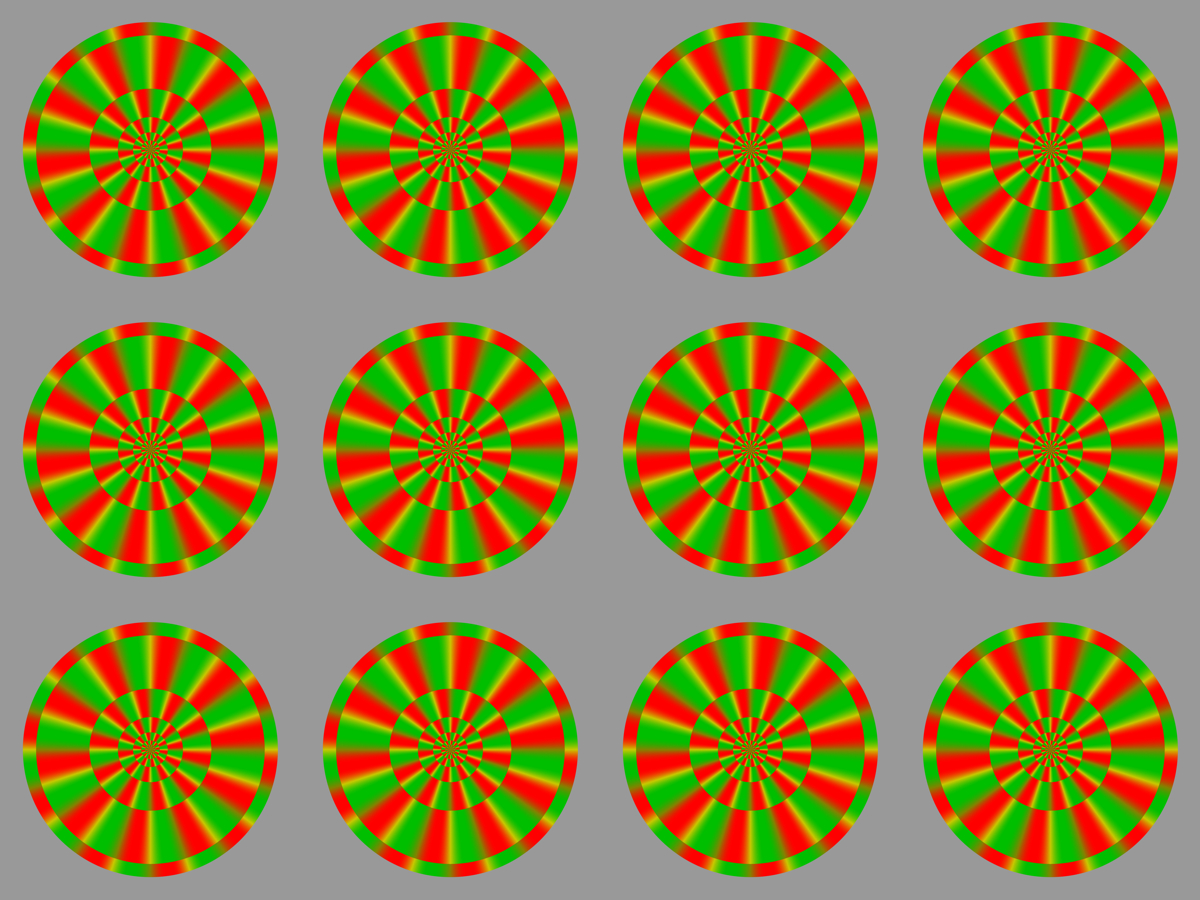
Illusion occurs with red and green.
Twitching illusion, a variation of the color-dependent type

Kitaoka, A. (2014). A new type of the color-dependent Fraser-Wilcox illusion. Perception 43 (37th) ECVP (Belgrade) Abstract Supplement, page 20 (Poster #17 August 25, 2014). Presentation (html) --- Poster (doc) --- Handout (doc) --- Illusion Night Handout (jpeg) --- Illusion Night Questionnaire (docx)

(Ellipses: R255, G0, B0; Background: R140, G140, B140)
Illusory clockwise rotation is observed.

(Ellipses: R255, G0, B0; Background: R200, G0, B255)
Illusory clockwise rotation is observed.

(Ellipses: R255, G0, B0; Background: R200, G130, B130)
Illusory clockwise rotation is observed.
Red might play an important role in the twitching illusion.
a related phenomenon
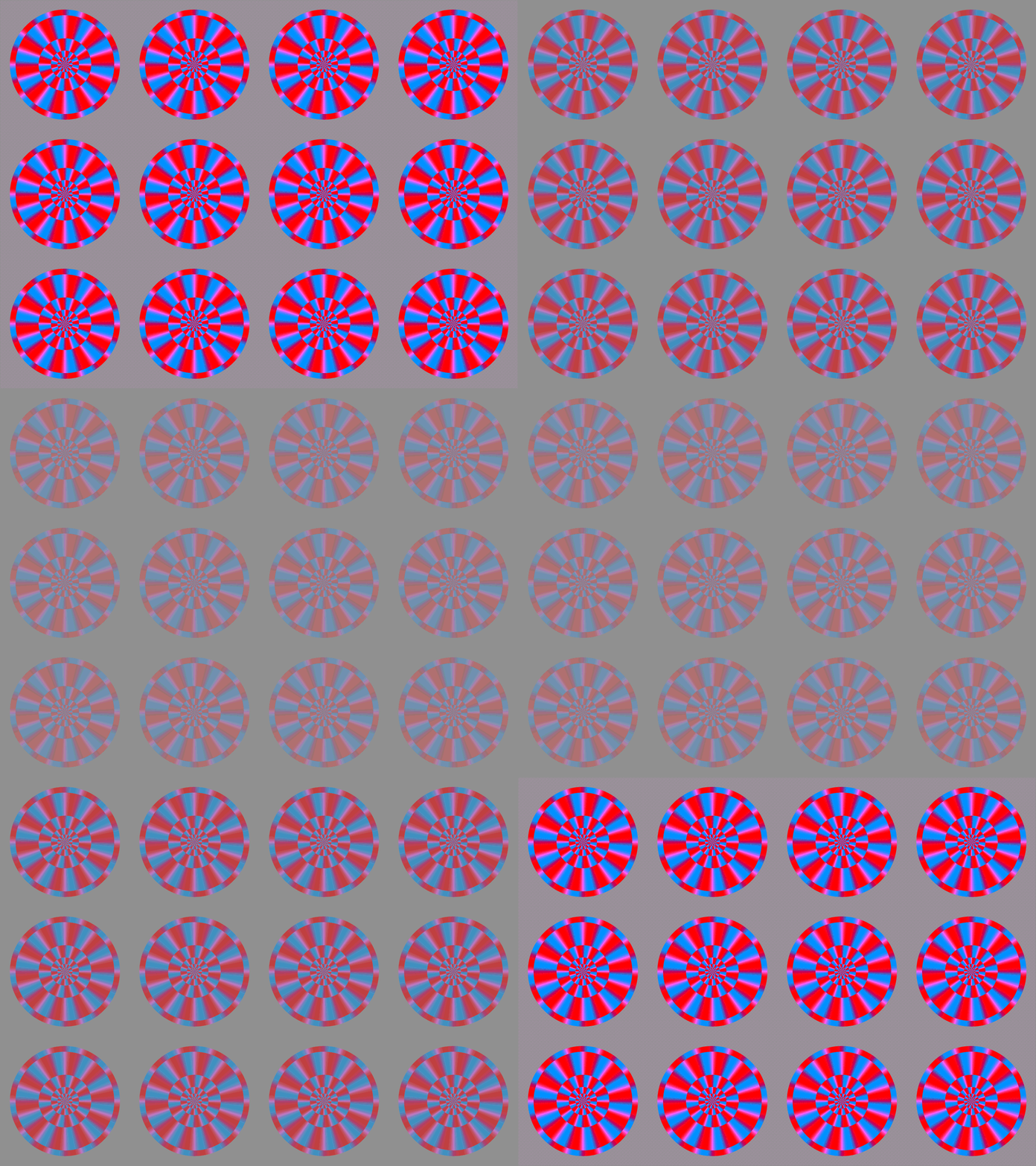
Fading-dependent motion illusion
Kitaoka, A. (2014). Motion illusion induced by color changes. 10th Asia-Pacific Conference on Vision (APCV), Sunport Takamatsu, Takamatsu, Japan, (Poster July 20, 2014 (P2-16)). Poster MS-Word doc file --- Movie demos
(GIF)
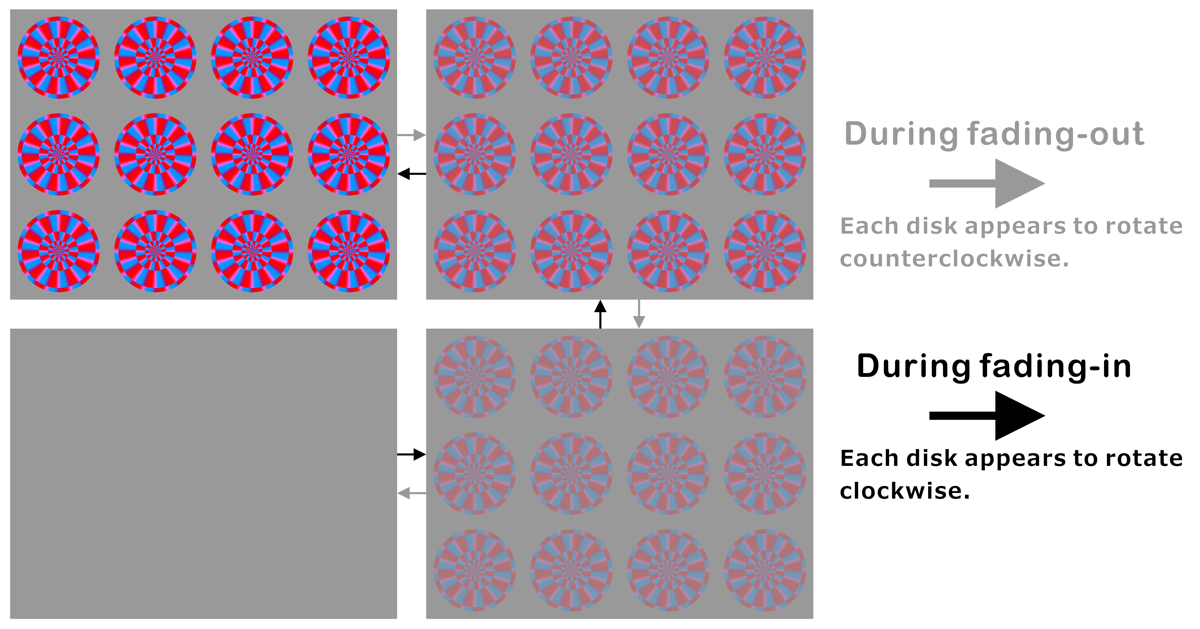
Each disk appears to rotate clockwise during fading-in while counterclockwise during fading-out.
Copyright Akiyoshi Kitaoka 2013 (February 19)
Copyright Akiyoshi Kitaoka 2014 (July 17)
Fading-dependent motion illusion depends on replacing color.
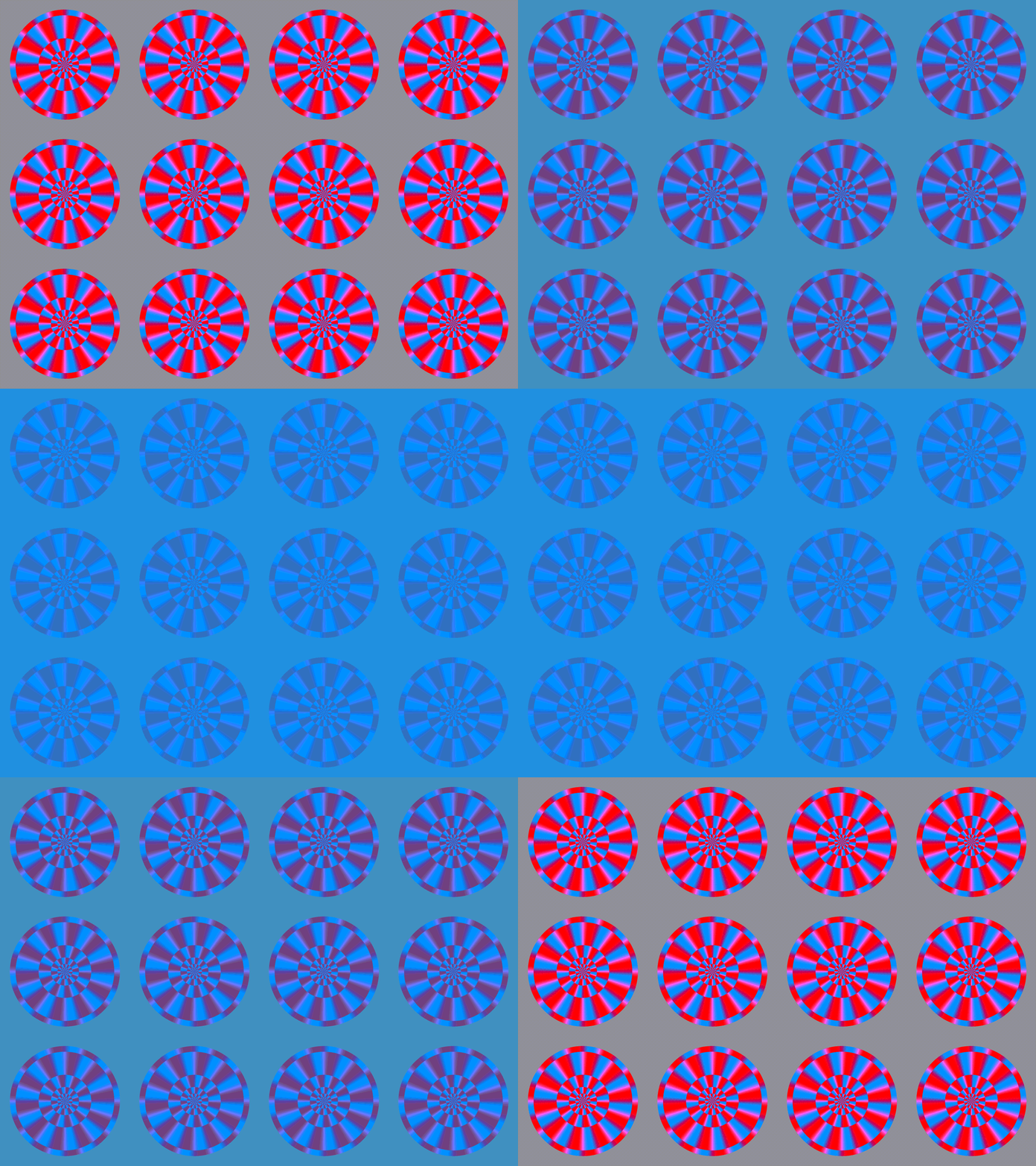
(Blue RGB = 0, 150, 255)
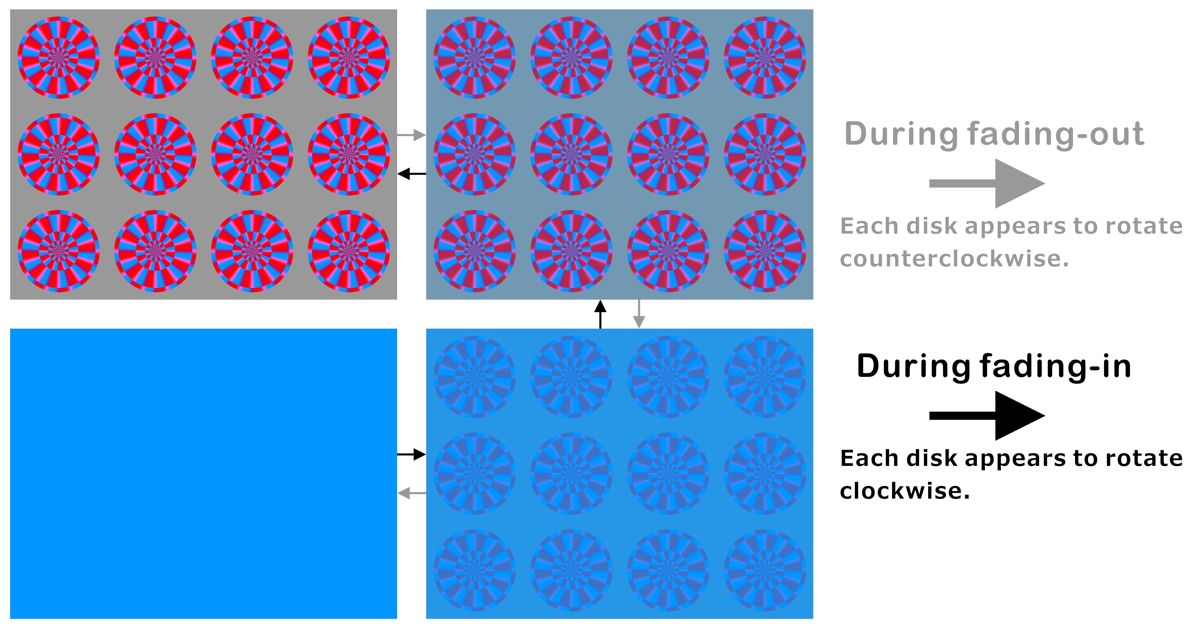
Copyright Akiyoshi Kitaoka 2014 (July 17)
Color change-dependent motion illusion #2
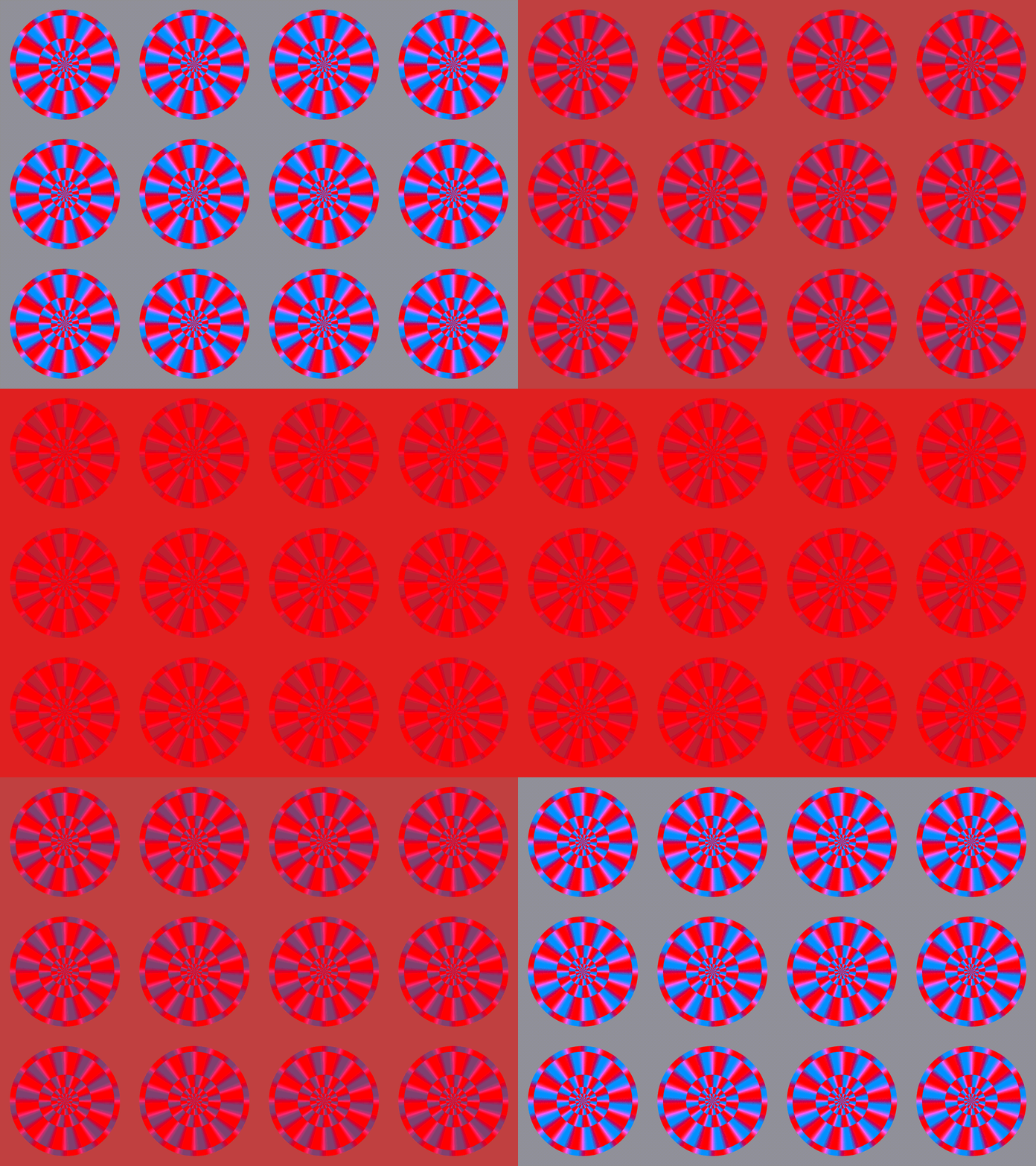
(Red RGB = 255, 0, 0)

Copyright Akiyoshi Kitaoka 2014 (July 17)

"On-off rotating snakes: red and sky blue #1"
When fading in, each disk appears to rotate in the direction: black, red, white, sky blue, black. The direction is reversed when fading out.
Copyright Akiyoshi Kitaoka 2013 (April 30) (GIF July 15, 2014)

"On-off rotating snakes: red and sky blue #2"
When fading in, each disk appears to rotate in the direction: black, sky blue, white, red, black. The direction is reversed when fading out.
Copyright Akiyoshi Kitaoka 2013 (April 30) (GIF July 15, 2014)
「蛇の回転」錯視の脳機能画像研究
Kuriki, I., Ashida, H., Murakami, I., & Kitaoka, A. (2008). Functional brain imaging of the Rotating Snakes illusion by fMRI. Journal of Vision, 8(10):16, 1-10. https://doi.org/10.1167/8.6.64
Takemura, H., Ashida, H., Amano, K., Kitaoka, A., & Murakami, I. (2012). Neural correlates of induced motion perception in the human brain. Journal of Neuroscience, 32(41):14344-14354. https://doi.org/10.1523/JNEUROSCI.0570-12.2012
フレーザー・ウィルコックス錯視群の主要な説明・モデル
(1)「知覚時間差」モデル・・・たとえば、コントラストの高い領域は早く知覚され、コントラストの低い領域は遅く知覚されると仮定することで、現象を説明する。
Backus, B. T., & Oruç I. (2005). Illusory motion from change over time in the response to contrast and luminance. Journal of Vision, 5(11), 1055-1069. https://doi.org/10.1167/5.11.10

(2)「運動知覚差」モデル・・・眼球は常に微細に動いており、それは全方向に動いていると仮定し、網膜上の特定のパターンの動きには強い運動信号を出すが、別の黄パターンの動きには弱い運動信号を出すと仮定して、現象を説明する。
Murakami, I., Kitaoka, A. & Ashida, H. (2006). A positive correlation between fixation instability and the strength of illusory motion in a static display. Vision Research, 46, 2421-2431. https://doi.org/10.1016/j.visres.2006.01.030
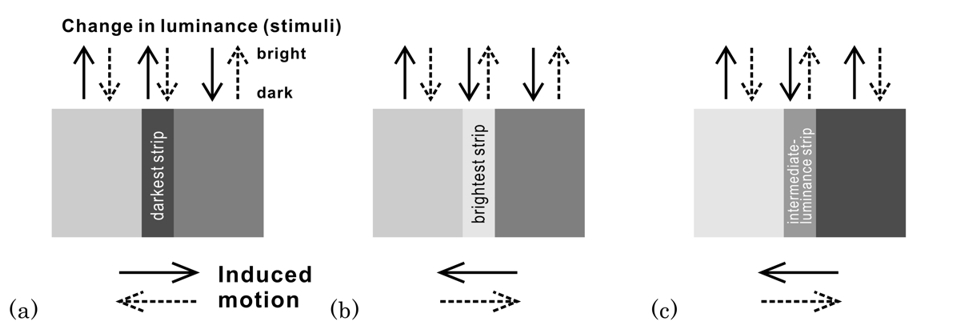
(3)「輝度変調誘導性の運動知覚」モデル(これでいきたいが、論文はまだない)・・・眼球運動時には視覚はオン・オフすると仮定して、オンまたはオフ時にはパターンによって知覚される輝度の変化があり、それが運動知覚となると仮定して、現象を説明する。
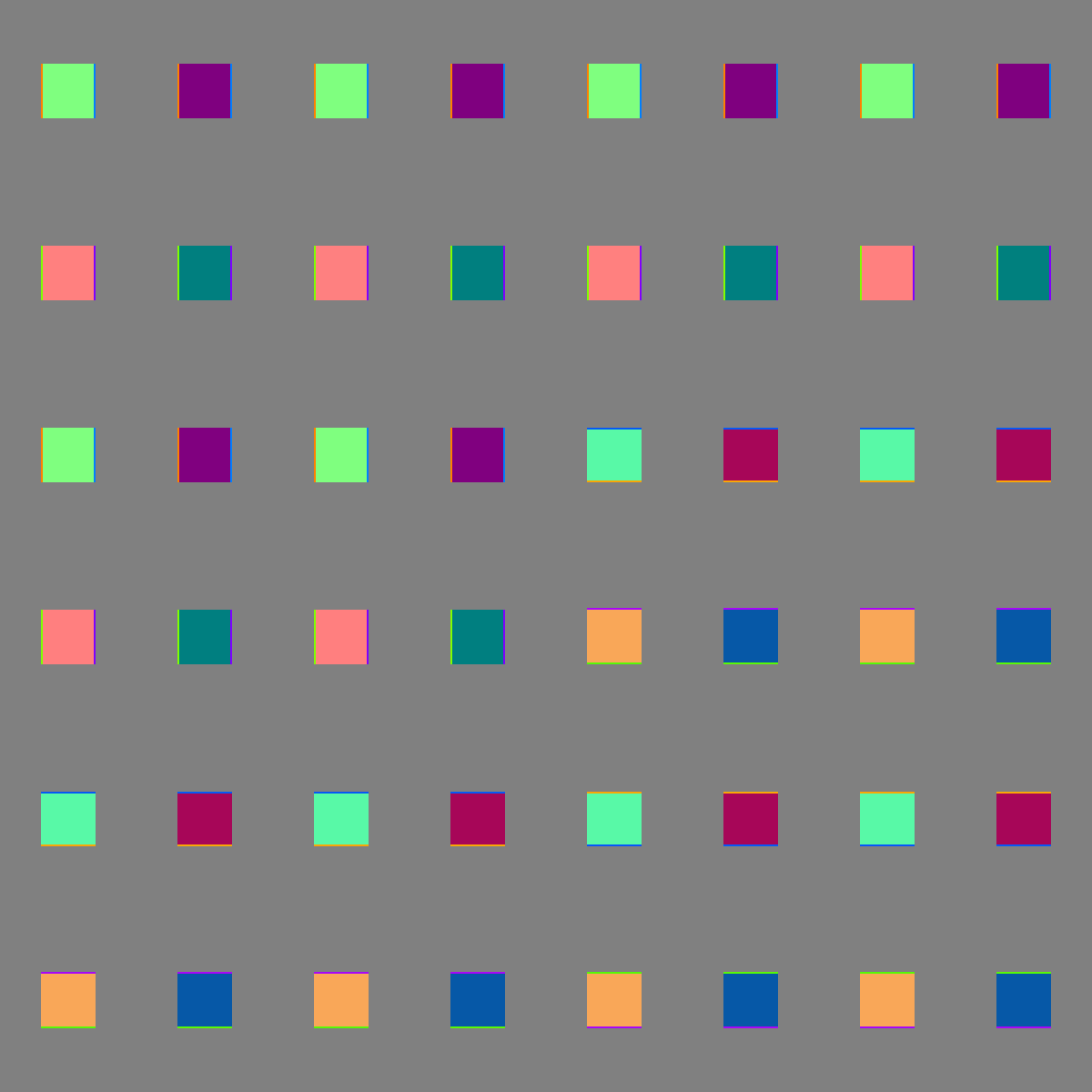
4 x 2 の配列の色の正方形は、それぞれ垂直・水平に整列していて、静止しているが、左右・上下に錯視的な動きをして見え、それらの錯視的動きの方向に位置がズレて見える。
Copyright Akiyoshi Kitaoka 2026 (June 7)
Refeneces
Flynn, O. F. & Shapiro, A. G. (2018). The perpetual diamond: contrast reversals along thin edges create the appearance of motion in objects. i-Perception, 9(6), 1–6. https://journals.sagepub.com/doi/full/10.1177/2041669518815708
じゃがりきん @jagarikin
https://x.com/jagarikin/status/1348136474517012481 (posted on January 10, 2021)
https://x.com/jagarikin/status/2006428954434089352 (posted on January 1, 2026)
Arthur Shapiro @agshapiro2 https://x.com/agshapiro2/status/1135286867182706688 (posted on June 3, 2019)
Kitaoka, A. (2006). Configurational coincidence among six phenomena: A comment on van Lier and Csathó (2006). Perception, 35, 799-806. https://doi.org/10.1068/p5319b --- Animations
この動画では、パターンが現れる時、時計回りに回転して見える。パターンが消える時には、反時計回りに回転して見える。
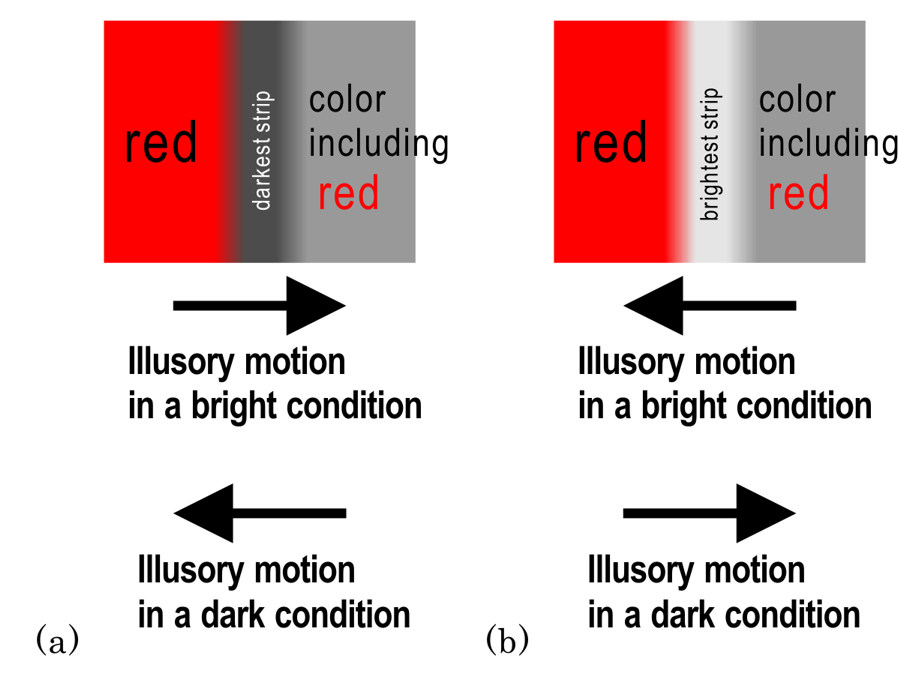
照明が明るい条件では、パターンが現れる時、時計回りに回転して見える。一方、パターンが消える時はよくわからない、
照明が暗い条件では、パターンが消える時、反時計回りに回転して見える。一方、パターンが現れる時はよくわからない、
Speculation: 上記の知見から想像すると、照明が明るい条件では、視覚がオフの状態からオンの状態に移行する時、少し時間をかけてものが見えてくるが、オンからオフに移行する時は速やかにものが消えて見えるのではないか。一方、照明が暗い条件では、視覚がオンの状態からオフの状態に移行する時、少し時間をかけてものが消えていくように見えるが、オフからオンに移行するのは速やかにものが見えてくるのではないか。
Further speculation: さらに、照明が明るい条件では、長波長領域(赤色)の知覚的な立ち上がり(オフからオンになる時の知覚される明るさの上昇)は短波長領域(水色や紫色)のそれよりも遅いと仮定すると、輝度変調誘導性の運動知覚(下図)で説明できる。同様に、照明が暗い条件では、長波長領域(赤色)の知覚的な立ち下がり(オンからオフになる時の知覚される明るさの低下)は短波長領域(水色や紫色)のそれよりも遅いと仮定すると、輝度変調誘導性の運動知覚で説明できる。
結論 上記のようにspeculationを重ねても、(1)色依存のフレーザー・ウィルコックス錯視に色温度が独立変数として働くのはなぜか、(2)赤と紫の画像と赤と水色の画像で錯視に差があるのはなぜか、という2つの問題には答えていない。また、「蛇の回転」などの色依存ではないフレーザー・ウィルコックス錯視群の錯視の機序についても何も語っていない。
Thank you !