
北岡のひとりごと 3
since June 19, 2025
ひとりごとというよりメモ帳
Thornton, I. M., Zdravković, S., Riga, A., Todorović, D. (2026). Dynamic illusory waves generated by relative motion in periodic displays. i-Perception, 17(4), 1–6. https://doi.org/10.1177/20416695261468555
Flynn, O., & Shapiro, A. (2014). A note concerning the relationship between the Adelson’s Argyle illusion and Cornsweet edges. Psihologija, 47(3), 353–358. https://doi.org/10.2298/PSI1403353F
Troncoso XG, Macknik SL, Martinez-Conde S. Novel visual illusions related to Vasarely's 'nested squares' show that corner salience varies with corner angle. Perception. 2005;34(4):409-20. https://doi.org/10.1068/p5383
Roncato S, Guidi S, Parlangeli O and Battaglini L (2016) Illusory Streaks from Corners and Their Perceptual Integration. Front. Psychol. 7:959. https://doi.org/10.3389/fpsyg.2016.00959
アンビグラム
https://note.com/msonrm/n/n5a4987733798
Giuliana Giovanelli
Giovanelli, G. (1966) Stati di tensione e di equilibrio nel campo percettivo. Rivista di Psicologia, 60, 327-335
https://psicologia.unibo.it/it/notizie/scomparsa-la-professoressa-giuliana-giovanelli
Anderson BL. Stereoscopic surface perception. Neuron. 1999 Dec;24(4):919-28. https://doi.org/10.1016/s0896-6273(00)81039-9 PMID: 10624955.
https://www.cell.com/neuron/fulltext/S0896-6273(00)81039-9
Peli, E., Goldstein, R., & Jung, J. H. (2023). The Invisibility of Scotomas I: The Carving Hypothesis. Optometry and vision science : official publication of the American Academy of Optometry, 100(8), 515–529. https://doi.org/10.1097/OPX.0000000000002048
He S, Davis WL. Filling-in at the natural blind spot contributes to binocular rivalry. Vision Res. 2001 Mar;41(7):835-40. https://doi.org/10.1016/s0042-6989(00)00315-1
「地平線近くに見える月は天頂付近に見える月よりも1.5%遠い」ということを初めて知りました(NASAのサイトにあるらしい)。意外と地球は大きくて月は近いのですね。今後のネタにしたいと思います。ついでに計算してみました。地球の半径は赤道上では6378km、地球から月までの距離は384400kmとのことですので(ChatGPT調べ。たぶんそんな数値)、天頂に月が見える時の距離を384400kmとすると、地平線近くでは384400+6378=390778kmです。その比、390778/384400=1.01692です。すなわち1.7%遠いです。引用されているNASAの文献では1.5%とのことで、これは赤道上ではなく、アメリカの緯度で計算したので少し値が小さいのでしょう。それでも結構大きいですね。月(ChatGPT調べで半径1737.4km)の目に映る大きさΘを2 arctan(月の半径/距離)で計算すると、天頂では0.517924度、地平線では0.509471度でした。その比は、0.517924/0.509471 = 1.01659 で、天頂の月の方が1.7%大きいです。この数値は距離比の1.7%と同じであることから推定すると、アメリカの緯度すなわち日本の緯度では、天頂の月は地平線の月よりも物理的には1.5%程度大きく見えていると考えられます。大きさの錯視があって1.5%大きく見えたという場合は、そこそこ大きい効果なので、この数値は錯視を考える上で軽視できません。すなわち、月の錯視とは、地平線の月は天空の月より1.5%(1-1/(1+0.015))網膜像は小さいというのにずいぶん大きく見えるという強力な錯視というわけです。
What color is this dot? New illusion demonstrates weird vision quirk
An optical illusion with nine simple dots reveals a surprising amount about the eye and brain
By Nora Bradford edited by Allison Parshall
Cavanagh, P. (1987). Reconstructing the third dimension: Interactions between color, texture, motion, binocular disparity, and shape. Computer Vision, Graphics, and Image Processing,
37, 2, 171-195. https://doi.org/10.1016/S0734-189X(87)80001-4
Koessler, T., & Hill, H. (2019). Focusing on an illusion: Accommodating to perceived depth? Vision Research, 154, 131-141. https://doi.org/10.1016/j.visres.2018.11.001
mirror gaze effect
Todorović D. (2006). Geometrical basis of perception of gaze direction. Vision Research, 46(21), 3549-3562. https://doi.org/10.1016/j.visres.2006.04.011
James Fraser
https://www.oxfordreference.com/display/10.1093/oi/authority.20110803095833389
It seems “Equality” (1992) by Octavio Ocampo.
Article | January 2013
Gamut relativity: A new computational approach to brightness and lightness perception
Tony Vladusich
Author Affiliations
Journal of Vision January 2013, Vol.13, 14. doi:https://doi.org/10.1167/13.1.14
Roncato S, Guidi S, Parlangeli O, Battaglini L. Illusory Streaks from Corners and Their Perceptual Integration. Front Psychol. 2016 Jun 23;7:959. doi: https://doi.org/10.3389/fpsyg.2016.00959
Sinha P, Crucilla S, Gandhi T, Rose D, Singh A, Ganesh S, Mathur U, & Bex P. (2020). Mechanisms underlying simultaneous brightness contrast: Early and innate. Vision Research, 173,41-49. https://10.1016/j.visres.2020.04.012
Ganel, T., & Goodale, M. A. (2003). Visual control of action but not perception requires analytical processing of object shape. Nature, 426(6967): 664-667. https://doi.org/10.1038/nature02156
Beck, D.M., Emanuele, B., & Savazzi, S. (2013). A new illusion of height and width: taller people are perceived as thinner. Psychonomic Bulletin & Review, 20, 1154–1160. https://doi.org/10.3758/s13423-013-0454-8
Daumail, L., Blake, R. & Tong, F. A reevaluation of the visual phantom illusion and its impact on the motion aftereffect. Sci Rep 15, 36358 (2025). https://doi.org/10.1038/s41598-025-20213-4
O.R. Kirubeswaran, Katherine R. Storrs,
Inconsistent illusory motion in predictive coding deep neural networks,
Vision Research,
Volume 206,
2023,
108195,
ISSN 0042-6989,
https://doi.org/10.1016/j.visres.2023.108195
Chi, M.-T., Lee, T.-Y., Qu, Y. and Wong, T. (2008) Self-Animating Images: Illusory Motion Using Repeated Asymmetric Patterns. ACM Transactions on Graphics (TOG), Vol. 3 No. 27, pp. 1–8, doi: https://doi.org/10.1145/1360612.1360661
Gladilin, E. and Eils, R. (2015) ‘On the role of spatial phase and phase correlation in vision, illusion, and cognition’, Frontiers in Computational Neuroscience, 9, 45. https://doi.org/10.3389/fncom.2015.00045
Gooch, A.A., Olsen, S.C., Tumblin, J. and Gooch, B. (2005) Color2Gray: Saliencepreserving color removal. ACM Transactions on Graphics, Vol. 24 No. 3, pp. 634–639, doi:10.1145/1073204.1073241.
Pinna B (2015) Directional organization and shape formation: new illusions and Helmholtz's Square. Front. Hum. Neurosci. 9:92. doi: 10.3389/fnhum.2015.00092
Zanker JM, Hermens F, Walker R. Quantifying and modeling the strength of motion illusions perceived in static patterns. J Vis. 2010 Feb 16;10(2):13.1-14. doi: 10.1167/10.2.13.
Wertheimer, M. (1912). Experimentelle Studien über das Sehen von Bewegung. Zeitschrift für Psychologie, 61, 161-265.
Dimmick, F. L. (1920). An Experimental Study of Visual Movement and the Phi Phenomenon. The American Journal of Psychology, 31, 317–332. https://doi.org/10.2307/1413667
Guilford, J. P., & Helson, H. (1929). Eye-movements and the phi-phenomenon. The American Journal of Psychology, 41, 595–606. https://doi.org/10.2307/1414716
Vogt, H. G., & Grant, W. (1927). A Study of the Phenomenon of Apparent Movement. The American Journal of Psychology, 38(1), 130–133. https://doi.org/10.2307/1414654
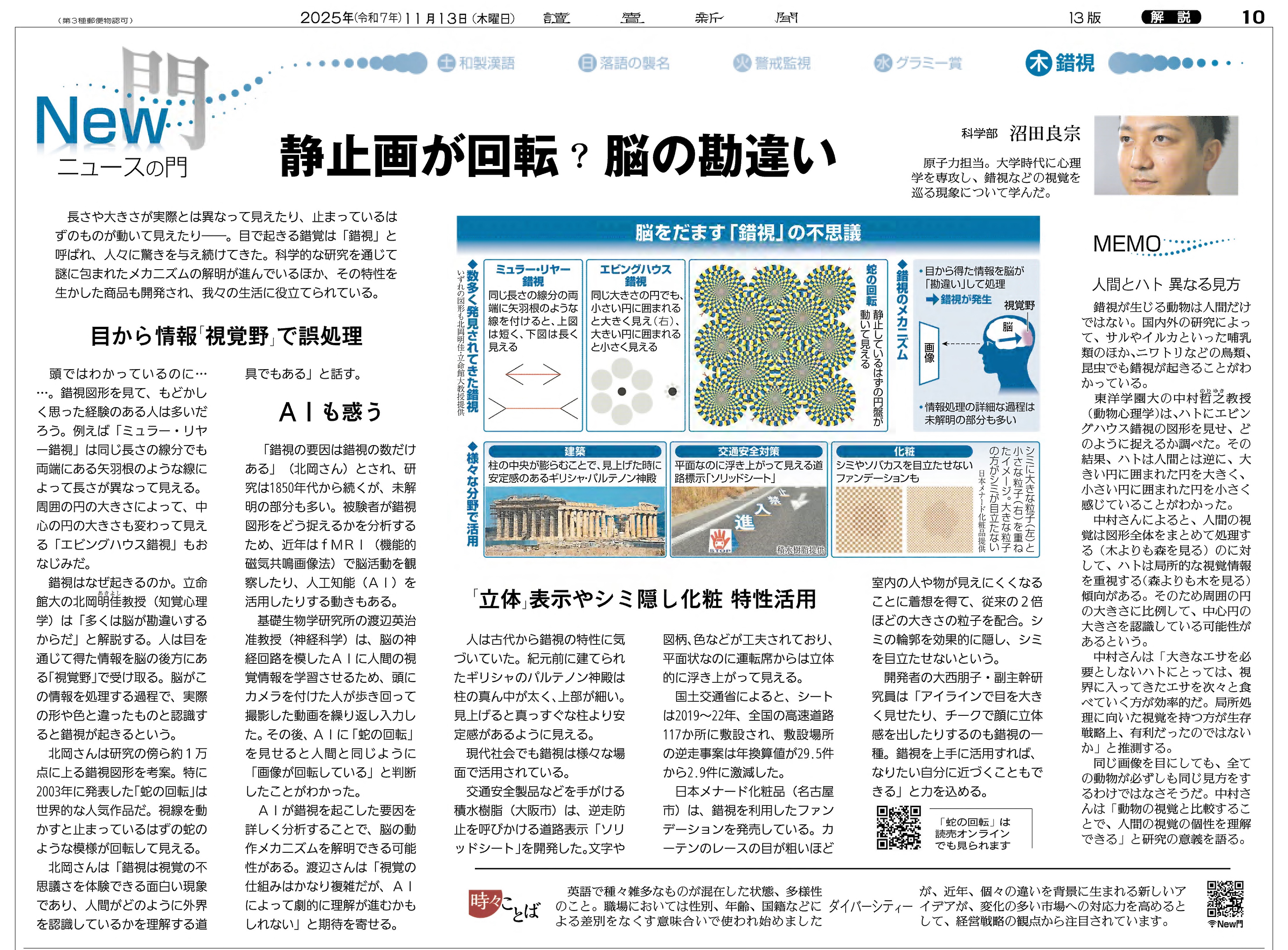
「AIも惑う、脳の勘違い「錯視」…特性生かした商品開発も」(読売)
https://news.yahoo.co.jp/articles/a05853f238d11a85d29feb1902e7b69d5ca5daa3?page=1
日経
https://www.nikkei.com/article/DGXZQOUD131WX0T11C25A0000000/
錯視の研究は、視覚を実験心理学的に研究する領域の一つとして発展してきた。錯視の「錯」には「まじる」などの意味があるが、ここでは「まちがえる」という意味で使われている。英語では錯視は "visual illusion" で、"illusion" は「対象の真の性質(と認識されたもの)とは異なるその対象の知覚」すなわち錯覚のことである。そうはいうものの、錯視は病的なものではなく健常なものである。錯視は「間違った」視覚と表現されていても、視覚としては正常に働いた結果、たまたま対象の性質と知覚が一致しなかった場合に、錯視というラベルが貼られているだけである。もっとも、対象の性質と知覚が一致しない現象なら何でも錯視と呼ばれるかというとそうではなく、おもしろいもの、不思議なもの、美しいものが錯視と呼ばれる傾向にある。すなわち、錯視は芸術と関係がある可能性がある。この関係性は、今後の錯視研究のテーマの一つになるかもしれない。
<November 5, 2025>
Cavanagh P. Using Illusions to Track the Emergence of Visual Perception. Annu Rev Vis Sci. 2024 Sep;10(1):1-22. https://doi.org/10.1146/annurev-vision-103023-012730. Epub 2024 Sep 19. PMID: 38871345.
Gori, S., & Stubbs, D. A. (2006). A New Set of Illusions—the Dynamic Luminance-Gradient Illusion and the Breathing Light Illusion. Perception, 35(11), 1573-1577. https://doi.org/10.1068/p5668 (Original work published 2006)
Oliva, A., & Torralba, A. (2006). Building the gist of a scene: The role of global image features in recognition. Progress in Brain Research, 155, 23–36.
谷中先生の2015年の色依存のFW錯視のポスター
https://f1000research.com/posters/4-676
Shapiro, A. G., Kobayashi, Y., & DeNavas, J. (2025). Two new visual phenomena inconsistent with an illumination assumption in two-dimensional images. Journal of the Optical Society of America. A, 42(5), B460–B466.
Wallach, H., & O'Connell, D. N. (1953). The kinetic depth effect. Journal of Experimental Psychology, 45(4), 205–217. https://doi.org/10.1037/h0056880
Sumi, S. (1989). Kinetic contours in rotating objects. Perception, 18(3), 293-302. https://doi.org/10.1068/p180293
Zanforlin, M. (1988). The height of a stereokinetic cone: a quantitative
determination of a 3-D effect from 2-D moving patterns without a "rigidity
assumption." Psvchological Research, 50, 162-172.
https://doi.org/10.1007/BF00310177
Nakamizo, S., & Kondo, M. (2009). Depth perception of stereokinetic
cone and absolute distance information. Japanese Psychological Research, 1995,
37(3), 139-145.
Released on J-STAGE February 24, 2009, Online ISSN 1468-5884, Print ISSN 0021-5368
https://doi.org/10.4992/psycholres1954.37.139
https://www.jstage.jst.go.jp/article/psycholres1954/37/3/37_3_139/_article/-char/en
Abstract: Magnitudes of the apparent depth of eccentric circles and real
cone stimuli were measured as a function of viewing distance when they
were rotated on a circular disc and viewed monocularly. The diameters of
the largest circle and base of the cone were 5, 10, 20, and 40 cm at the
viewing distances, 0.5, 1, 2, and 4 m, respectively. The height of each
cone was equal to the diameter of its base. The cones were tilted 15 deg
from the fronto-parallel plane so that their retinal images approximated
to those of the eccentric circles stimuli. Eight observers produced the
magnitude of depth of the perceived stimuli at each of the four viewing
distances. The mean magnitude of the apparent depth for the eccentric circles
stimulus increased linearly as a function of the viewing distance. The
height of the cone stimulus was perceived veridically. The results of the
experiment are consistent with the motion parallax hypothesis which states
that the visual system calibrates motion parallax according to absolute
distance information in processing stereokinetic depth.
Ömer Dağlar Tanrıkulu, Vicky Froyen, Jacob Feldman, Manish Singh; Geometric figure–ground cues override standard depth from accretion-deletion. Journal of Vision 2016;16(5):15. https://doi.org/10.1167/16.5.15
Gerbino, W. (2020). Amodal Completion Revisited. I-Perception, 11(4). https://doi.org/10.1177/2041669520937323
https://journals.sagepub.com/doi/10.1177/2041669520937323
https://pmc.ncbi.nlm.nih.gov/articles/PMC7466902/
Gomez-Villa, A., Wang, K., Parraga, C. A., Twardowski, B., Malo, J., Vazquez-Corral, J., & van den Weijer, J. (2025). The Art of Deception: Color Visual Illusions and Diffusion Models. In Proceedings of the Computer Vision and Pattern Recognition Conference (pp. 18642-18652). Web site
